Imagine you’re working at a customer service call center. Throughout our previous chapters, we’ve mastered the art of describing “counts” - binomial distributions and Poisson distributions tell us how many times events occur . But now, we want to ask a fundamentally different question: How long do we need to wait until the first event occurs?
Discrete Problems (Already Solved):
“How many customer calls do we receive in one day?” → Answer: An integer (0, 1, 2, 3, …), described by Poisson distribution
“How many defective products in a batch of 100?” → Answer: An integer (0 to 100), described by binomial distribution
Continuous Problems (New Challenge):
“Starting from this moment, how long must we wait until the next customer call?” → Answer: A positive real number (like 5.2 minutes)
“What is the exact weight of a randomly selected product?” → Answer: A real number with potentially infinite precision
The fundamental challenge with continuous random variables is that there are infinitely many possible values, so the probability of any exact value is zero. Instead, we think about probability density .
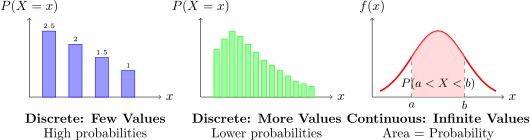
Let’s understand this concept by observing what happens as we increase the number of possible values:
Discrete: Few Values — High probabilities (each bar is tall)
Discrete: More Values — Lower probabilities (bars shrink as more values share the total)
Continuous: Infinite Values — Area under the curve equals probability
P ( a < X < b ) = Area under f ( x ) between a and b P(a < X < b) = \text{Area under } f(x) \text{ between } a \text{ and } b P ( a < X < b ) = Area under f ( x ) between a and b
Observe the pattern:
Few discrete values: Each individual probability is substantial (like 0.3, 0.2, 0.15…)Many discrete values: Each individual probability becomes smaller (like 0.05, 0.03, 0.02…)Infinite continuous values: Each individual probability becomes zero, but the density f ( x ) f(x) f ( x ) The fundamental shift: We move from asking “What’s P ( X = 5 ) P(X = 5) P ( X = 5 ) P ( 4.9 < X < 5.1 ) P(4.9 < X < 5.1) P ( 4.9 < X < 5.1 )
This visualization shows us why we need a new mathematical framework for continuous random variables. The “height” of the curve at any point represents the probability density, and the area under the curve between two points gives us the actual probability.
Definition (Probability Density Function):
For a continuous random variable X X X f ( x ) f(x) f ( x )
f ( x ) ≥ 0 f(x) \geq 0 f ( x ) ≥ 0 x x x P ( a < X < b ) = ∫ a b f ( x ) d x P(a < X < b) = \int_a^b f(x) \, dx P ( a < X < b ) = ∫ a b f ( x ) d x ∫ − ∞ ∞ f ( x ) d x = 1 \int_{-\infty}^{\infty} f(x) \, dx = 1 ∫ − ∞ ∞ f ( x ) d x = 1
Crucial Point: f ( x ) f(x) f ( x ) not a probability - it’s a probability density .
A large value of f ( x ) f(x) f ( x ) X X X x x x
For any specific point a a a P ( X = a ) = 0 P(X = a) = 0 P ( X = a ) = 0
This aligns with geometric intuition - the probability of hitting an exact point on a line is zero
Example:
Consider a random variable X X X
f ( x ) = { 2 x 9 if 0 ≤ x ≤ 3 0 otherwise f(x) = \begin{cases} \frac{2x}{9} & \text{if } 0 \leq x \leq 3 \\ 0 & \text{otherwise} \end{cases} f ( x ) = { 9 2 x 0 if 0 ≤ x ≤ 3 otherwise
Part (a): Verify this is a valid PDF
We need to check two fundamental conditions:
Condition (i): f ( x ) ≥ 0 f(x) \geq 0 f ( x ) ≥ 0 x x x
For 0 ≤ x ≤ 3 0 \leq x \leq 3 0 ≤ x ≤ 3 f ( x ) = 2 x 9 ≥ 0 f(x) = \frac{2x}{9} \geq 0 f ( x ) = 9 2 x ≥ 0 x ≥ 0 x \geq 0 x ≥ 0
For x < 0 x < 0 x < 0 x > 3 x > 3 x > 3 f ( x ) = 0 ≥ 0 f(x) = 0 \geq 0 f ( x ) = 0 ≥ 0
Condition (ii): ∫ − ∞ ∞ f ( x ) d x = 1 \int_{-\infty}^{\infty} f(x) \, dx = 1 ∫ − ∞ ∞ f ( x ) d x = 1
∫ − ∞ ∞ f ( x ) d x = ∫ 0 3 2 x 9 d x = 2 9 ⋅ x 2 2 ∣ 0 3 = 1 9 ⋅ 9 = 1 \int_{-\infty}^{\infty} f(x) \, dx = \int_0^3 \frac{2x}{9} \, dx = \frac{2}{9} \cdot \frac{x^2}{2}\Big|_0^3 = \frac{1}{9} \cdot 9 = 1 ∫ − ∞ ∞ f ( x ) d x = ∫ 0 3 9 2 x d x = 9 2 ⋅ 2 x 2 0 3 = 9 1 ⋅ 9 = 1
Part (b): Find P ( 1 < X < 2 ) P(1 < X < 2) P ( 1 < X < 2 )
P ( 1 < X < 2 ) = ∫ 1 2 2 x 9 d x = 2 9 ⋅ x 2 2 ∣ 1 2 = 1 9 ( 4 − 1 ) = 1 3 P(1 < X < 2) = \int_1^2 \frac{2x}{9} \, dx = \frac{2}{9} \cdot \frac{x^2}{2}\Big|_1^2 = \frac{1}{9}(4-1) = \boxed{\frac{1}{3}} P ( 1 < X < 2 ) = ∫ 1 2 9 2 x d x = 9 2 ⋅ 2 x 2 1 2 = 9 1 ( 4 − 1 ) = 3 1
Definition (Cumulative Distribution Function):
The cumulative distribution function is defined as:
F ( x ) = P ( X ≤ x ) = ∫ − ∞ x f ( t ) d t F(x) = P(X \leq x) = \int_{-\infty}^{x} f(t) \, dt F ( x ) = P ( X ≤ x ) = ∫ − ∞ x f ( t ) d t
This represents the probability that the random variable takes a value less than or equal to x x x
For any continuous random variable with CDF F ( x ) F(x) F ( x )
1. Non-decreasing: If x 1 < x 2 x_1 < x_2 x 1 < x 2 F ( x 1 ) ≤ F ( x 2 ) F(x_1) \leq F(x_2) F ( x 1 ) ≤ F ( x 2 )
Intuition: As we move right on the number line, we can only accumulate more probability, never lose it 2. Continuous: For a piecewisely defined CDF, the values are consistent at the points where the pieces meet.
3. Range: 0 ≤ F ( x ) ≤ 1 0 \leq F(x) \leq 1 0 ≤ F ( x ) ≤ 1 x x x
Interpretation: CDF represents cumulative probability, which must be between 0 and 1 4. Probability calculation: P ( a < X < b ) = P ( a ≤ X ≤ b ) = P ( a < X ≤ b ) = F ( b ) − F ( a ) P(a < X < b) = P(a \leq X \leq b) = P(a < X \leq b) = F(b) - F(a) P ( a < X < b ) = P ( a ≤ X ≤ b ) = P ( a < X ≤ b ) = F ( b ) − F ( a )
Theorem (Fundamental Relationship between PDF and CDF):
For continuous random variables:
f ( x ) = d d x F ( x ) f(x) = \frac{d}{dx} F(x) f ( x ) = d x d F ( x )
This means:
The CDF is the integral of the PDF
The PDF is the derivative of the CDF
This is the Fundamental Theorem of Calculus perfectly embodied in probability theory!
Example (From CDF to PDF):
A continuous random variable X X X
F ( x ) = { 0 x < 0 x 3 8 0 ≤ x ≤ 2 1 x > 2 F(x) = \begin{cases} 0 & x < 0 \\ \frac{x^3}{8} & 0 \leq x \leq 2 \\ 1 & x > 2 \end{cases} F ( x ) = ⎩ ⎨ ⎧ 0 8 x 3 1 x < 0 0 ≤ x ≤ 2 x > 2
Part (a): Find the PDF f ( x ) f(x) f ( x )
Using the fundamental relationship f ( x ) = d d x F ( x ) f(x) = \frac{d}{dx} F(x) f ( x ) = d x d F ( x )
For x < 0 x < 0 x < 0 f ( x ) = d d x ( 0 ) = 0 f(x) = \frac{d}{dx}(0) = 0 f ( x ) = d x d ( 0 ) = 0
For 0 ≤ x ≤ 2 0 \leq x \leq 2 0 ≤ x ≤ 2 f ( x ) = d d x ( x 3 8 ) = 3 x 2 8 f(x) = \frac{d}{dx}\left(\frac{x^3}{8}\right) = \frac{3x^2}{8} f ( x ) = d x d ( 8 x 3 ) = 8 3 x 2
For x > 2 x > 2 x > 2 f ( x ) = d d x ( 1 ) = 0 f(x) = \frac{d}{dx}(1) = 0 f ( x ) = d x d ( 1 ) = 0
Therefore:
f ( x ) = { 3 x 2 8 0 ≤ x ≤ 2 0 otherwise \boxed{f(x) = \begin{cases} \frac{3x^2}{8} & 0 \leq x \leq 2 \\ 0 & \text{otherwise} \end{cases}} f ( x ) = { 8 3 x 2 0 0 ≤ x ≤ 2 otherwise
Part (b): Verify this is a valid PDF
Check that ∫ − ∞ ∞ f ( x ) d x = 1 \int_{-\infty}^{\infty} f(x) \, dx = 1 ∫ − ∞ ∞ f ( x ) d x = 1
∫ − ∞ ∞ f ( x ) d x = ∫ 0 2 3 x 2 8 d x = 3 8 ⋅ x 3 3 ∣ 0 2 = 1 8 ⋅ 8 = 1 \int_{-\infty}^{\infty} f(x) \, dx = \int_0^2 \frac{3x^2}{8} \, dx = \frac{3}{8} \cdot \frac{x^3}{3}\Big|_0^2 = \frac{1}{8} \cdot 8 = 1 ∫ − ∞ ∞ f ( x ) d x = ∫ 0 2 8 3 x 2 d x = 8 3 ⋅ 3 x 3 0 2 = 8 1 ⋅ 8 = 1
Part (c): Find P ( 0.5 < X < 1.5 ) P(0.5 < X < 1.5) P ( 0.5 < X < 1.5 )
Using the CDF method: P ( 0.5 < X < 1.5 ) = F ( 1.5 ) − F ( 0.5 ) P(0.5 < X < 1.5) = F(1.5) - F(0.5) P ( 0.5 < X < 1.5 ) = F ( 1.5 ) − F ( 0.5 )
P ( 0.5 < X < 1.5 ) = F ( 1.5 ) − F ( 0.5 ) = ( 1.5 ) 3 8 − ( 0.5 ) 3 8 = 3.375 − 0.125 8 = 3.25 8 = 0.40625 \begin{aligned} P(0.5 < X < 1.5) &= F(1.5) - F(0.5) \\ &= \frac{(1.5)^3}{8} - \frac{(0.5)^3}{8} \\ &= \frac{3.375 - 0.125}{8} \\ &= \frac{3.25}{8} = \boxed{0.40625} \end{aligned} P ( 0.5 < X < 1.5 ) = F ( 1.5 ) − F ( 0.5 ) = 8 ( 1.5 ) 3 − 8 ( 0.5 ) 3 = 8 3.375 − 0.125 = 8 3.25 = 0.40625
Example (In-Class Exercise):
A continuous random variable Y Y Y
F ( y ) = { 0 y < 1 a ( y − 1 ) 2 1 ≤ y ≤ 3 1 y > 3 F(y) = \begin{cases} 0 & y < 1 \\ a(y-1)^2 & 1 \leq y \leq 3 \\ 1 & y > 3 \end{cases} F ( y ) = ⎩ ⎨ ⎧ 0 a ( y − 1 ) 2 1 y < 1 1 ≤ y ≤ 3 y > 3
where a a a
Find the value of a a a
Determine the probability density function f ( y ) f(y) f ( y )
Calculate P ( Y > 2 ) P(Y > 2) P ( Y > 2 )
Your solutions:
In our study of discrete random variables, we learned to calculate expected values using weighted sums:
E ( X ) = ∑ i x i ⋅ P ( X = x i ) E(X) = \sum_{i} x_i \cdot P(X = x_i) E ( X ) = ∑ i x i ⋅ P ( X = x i )
But what happens when we transition to continuous variables where P ( X = x i ) = 0 P(X = x_i) = 0 P ( X = x i ) = 0 sums become integrals .
Discrete Case: E ( X ) = ∑ i x i ⋅ P ( X = x i ) E(X) = \sum_i x_i \cdot P(X = x_i) E ( X ) = ∑ i x i ⋅ P ( X = x i )
Each value x i x_i x i P ( X = x i ) P(X = x_i) P ( X = x i )
We sum over all possible discrete values
Continuous Case: E ( X ) = ∫ − ∞ ∞ x ⋅ f ( x ) d x E(X) = \int_{-\infty}^{\infty} x \cdot f(x) \, dx E ( X ) = ∫ − ∞ ∞ x ⋅ f ( x ) d x
Each value x x x f ( x ) f(x) f ( x )
We integrate over all possible continuous values
The integral represents the “limit of increasingly fine sums”
Physical Interpretation: Think of f ( x ) f(x) f ( x )
Definition (Expected Value and Variance for Continuous Random Variables):
For a continuous random variable X X X f ( x ) f(x) f ( x )
Expected Value (Mean):
E ( X ) = ∫ − ∞ ∞ x ⋅ f ( x ) d x E(X) = \int_{-\infty}^{\infty} x \cdot f(x) \, dx E ( X ) = ∫ − ∞ ∞ x ⋅ f ( x ) d x
This represents the “center of gravity” or average value of the distribution.
Variance:
Var ( X ) = E [ ( X − μ ) 2 ] = ∫ − ∞ ∞ ( x − μ ) 2 f ( x ) d x = E ( X 2 ) − [ E ( X ) ] 2 \text{Var}(X) = E[(X-\mu)^2] = \int_{-\infty}^{\infty} (x-\mu)^2 f(x) \, dx = E(X^2) - [E(X)]^2 Var ( X ) = E [( X − μ ) 2 ] = ∫ − ∞ ∞ ( x − μ ) 2 f ( x ) d x = E ( X 2 ) − [ E ( X ) ] 2
This measures the “spread” or dispersion around the mean.
Expected Value of a Function:
E [ g ( X ) ] = ∫ − ∞ ∞ g ( x ) f ( x ) d x E[g(X)] = \int_{-\infty}^{\infty} g(x) f(x) \, dx E [ g ( X )] = ∫ − ∞ ∞ g ( x ) f ( x ) d x
This powerful formula allows us to find the expected value of any transformation of X X X
Theorem (Linear Transformations):
For a continuous random variable X X X a a a b b b
E ( a X + b ) = a E ( X ) + b E(aX + b) = aE(X) + b E ( a X + b ) = a E ( X ) + b Var ( a X + b ) = a 2 Var ( X ) \text{Var}(aX + b) = a^2 \text{Var}(X) Var ( a X + b ) = a 2 Var ( X )
Example (Beta-type Distribution):
Consider the continuous random variable X X X
f ( x ) = { 6 x ( 1 − x ) 0 ≤ x ≤ 1 0 otherwise f(x) = \begin{cases} 6x(1-x) & 0 \leq x \leq 1 \\ 0 & \text{otherwise} \end{cases} f ( x ) = { 6 x ( 1 − x ) 0 0 ≤ x ≤ 1 otherwise
Complete Solution:
Part (a): Verify this is a valid PDF
Check that ∫ − ∞ ∞ f ( x ) d x = 1 \int_{-\infty}^{\infty} f(x) \, dx = 1 ∫ − ∞ ∞ f ( x ) d x = 1
∫ 0 1 6 x ( 1 − x ) d x = 6 ∫ 0 1 ( x − x 2 ) d x = 6 [ x 2 2 − x 3 3 ] 0 1 = 6 ( 1 2 − 1 3 ) = 6 ⋅ 1 6 = 1 \begin{aligned} \int_0^1 6x(1-x) \, dx &= 6\int_0^1 (x - x^2) \, dx \\ &= 6\left[\frac{x^2}{2} - \frac{x^3}{3}\right]_0^1 \\ &= 6\left(\frac{1}{2} - \frac{1}{3}\right) = 6 \cdot \frac{1}{6} = 1 \end{aligned} ∫ 0 1 6 x ( 1 − x ) d x = 6 ∫ 0 1 ( x − x 2 ) d x = 6 [ 2 x 2 − 3 x 3 ] 0 1 = 6 ( 2 1 − 3 1 ) = 6 ⋅ 6 1 = 1
Part (b): Calculate E ( X ) E(X) E ( X )
E ( X ) = ∫ 0 1 x ⋅ 6 x ( 1 − x ) d x = 6 ∫ 0 1 ( x 2 − x 3 ) d x E(X) = \int_0^1 x \cdot 6x(1-x) \, dx = 6\int_0^1 (x^2 - x^3) \, dx E ( X ) = ∫ 0 1 x ⋅ 6 x ( 1 − x ) d x = 6 ∫ 0 1 ( x 2 − x 3 ) d x
= 6 [ x 3 3 − x 4 4 ] 0 1 = 6 ( 1 3 − 1 4 ) = 1 2 = 6\left[\frac{x^3}{3} - \frac{x^4}{4}\right]_0^1 = 6\left(\frac{1}{3} - \frac{1}{4}\right) = \boxed{\frac{1}{2}} = 6 [ 3 x 3 − 4 x 4 ] 0 1 = 6 ( 3 1 − 4 1 ) = 2 1
Part (c): Calculate Var ( X ) \text{Var}(X) Var ( X )
Step 1: Find E ( X 2 ) E(X^2) E ( X 2 )
E ( X 2 ) = ∫ 0 1 x 2 ⋅ 6 x ( 1 − x ) d x = 6 ∫ 0 1 ( x 3 − x 4 ) d x E(X^2) = \int_0^1 x^2 \cdot 6x(1-x) \, dx = 6\int_0^1 (x^3 - x^4) \, dx E ( X 2 ) = ∫ 0 1 x 2 ⋅ 6 x ( 1 − x ) d x = 6 ∫ 0 1 ( x 3 − x 4 ) d x
= 6 [ x 4 4 − x 5 5 ] 0 1 = 6 ( 1 4 − 1 5 ) = 3 10 = 6\left[\frac{x^4}{4} - \frac{x^5}{5}\right]_0^1 = 6\left(\frac{1}{4} - \frac{1}{5}\right) = \frac{3}{10} = 6 [ 4 x 4 − 5 x 5 ] 0 1 = 6 ( 4 1 − 5 1 ) = 10 3
Step 2: Apply variance formula
Var ( X ) = E ( X 2 ) − [ E ( X ) ] 2 = 3 10 − ( 1 2 ) 2 = 3 10 − 1 4 = 1 20 \text{Var}(X) = E(X^2) - [E(X)]^2 = \frac{3}{10} - \left(\frac{1}{2}\right)^2 = \frac{3}{10} - \frac{1}{4} = \boxed{\frac{1}{20}} Var ( X ) = E ( X 2 ) − [ E ( X ) ] 2 = 10 3 − ( 2 1 ) 2 = 10 3 − 4 1 = 20 1
Definition (Percentiles and Quantiles):
The p p p q p q_p q p
P ( X ≤ q p ) = F ( q p ) = p 100 P(X \leq q_p) = F(q_p) = \frac{p}{100} P ( X ≤ q p ) = F ( q p ) = 100 p
Interpretation: p % p\% p % q p q_p q p ( 100 − p ) % (100-p)\% ( 100 − p ) %
Special cases:
Median (q 50 q_{50} q 50 F ( q 50 ) = 0.5 F(q_{50}) = 0.5 F ( q 50 ) = 0.5 First Quartile (q 25 q_{25} q 25 Third Quartile (q 75 q_{75} q 75
Definition (Mode):
The mode of a continuous distribution is the value of x x x f ( x ) f(x) f ( x )
d d x f ( x ) = 0 and d 2 d x 2 f ( x ) < 0 \frac{d}{dx} f(x) = 0 \text{ and } \frac{d^2}{dx^2} f(x) < 0 d x d f ( x ) = 0 and d x 2 d 2 f ( x ) < 0
The mode represents the most “dense” point of the distribution - where the probability is most concentrated.
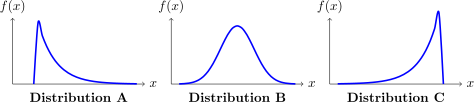
Example (Visual Skewness Detection Practice):
Look at these three distributions. Roughly denote the mode, median, and mean, and identify their skewness:
This is the most practical method for determining skewness:
Distribution Type Relationship Interpretation Symmetric Mean = = = = = = No skewness Right-skewed Mean > > > > > > Positive skew Left-skewed Mean < < < < < < Negative skew
Why this works: The mean is “pulled” toward the tail because it’s sensitive to extreme values, while the median and mode are more resistant to outliers.
Distribution A: Right-skewed (long right tail)
Distribution B: Symmetric (bell-shaped)
Distribution C: Left-skewed (long left tail)
Example (In-Class Exercise):
A continuous random variable Z Z Z
f ( z ) = { c e − 2 z z ≥ 0 0 z < 0 f(z) = \begin{cases} ce^{-2z} & z \geq 0 \\ 0 & z < 0 \end{cases} f ( z ) = { c e − 2 z 0 z ≥ 0 z < 0
where c c c
Find the value of c c c
Calculate E ( Z ) E(Z) E ( Z ) Var ( Z ) \text{Var}(Z) Var ( Z )
Find P ( Z > E ( Z ) ) P(Z > E(Z)) P ( Z > E ( Z ))
Find E ( 3 Z + 2 ) E(3Z + 2) E ( 3 Z + 2 ) Var ( 3 Z + 2 ) \text{Var}(3Z + 2) Var ( 3 Z + 2 )
Calculate P ( Z > 1 ∣ Z > 0.5 ) P(Z > 1 | Z > 0.5) P ( Z > 1∣ Z > 0.5 )
Calculate the median and interquartile range of Z Z Z
Sketch f ( z ) f(z) f ( z )
Your solutions:
A continuous random variable X X X
F ( x ) = { 0 x < 1 1 5 ( x − 1 ) 1 ≤ x ≤ 6 1 x > 6 F(x) = \begin{cases} 0 & x < 1 \\ \frac{1}{5}(x-1) & 1 \leq x \leq 6 \\ 1 & x > 6 \end{cases} F ( x ) = ⎩ ⎨ ⎧ 0 5 1 ( x − 1 ) 1 x < 1 1 ≤ x ≤ 6 x > 6
Find P(X > 4 X > 4 X > 4
Write down the value of P(X ≠ 4 X \neq 4 X = 4
Find the probability density function of X X X x x x
Write down the value of E(X X X
Find Var(X X X
Hence or otherwise find E(3 X 2 + 1 3X^2 + 1 3 X 2 + 1
The random variable X X X f ( x ) f(x) f ( x )
f ( x ) = { k ( x 2 + a ) − 1 < x ≤ 2 3 k 2 < x ≤ 3 0 otherwise f(x) = \begin{cases} k(x^2 + a) & -1 < x \leq 2 \\ 3k & 2 < x \leq 3 \\ 0 & \text{otherwise} \end{cases} f ( x ) = ⎩ ⎨ ⎧ k ( x 2 + a ) 3 k 0 − 1 < x ≤ 2 2 < x ≤ 3 otherwise
where k k k a a a
Given that E(X X X 17 12 \frac{17}{12} 12 17
Find the value of k k k a a a
Write down the mode of X X X
A random variable X X X x x x
F ( x ) = { 0 x < 0 x 2 20 ( 9 − 2 x ) 0 ≤ x ≤ 2 1 x > 2 F(x) = \begin{cases} 0 & x < 0 \\ \frac{x^2}{20}(9-2x) & 0 \leq x \leq 2 \\ 1 & x > 2 \end{cases} F ( x ) = ⎩ ⎨ ⎧ 0 20 x 2 ( 9 − 2 x ) 1 x < 0 0 ≤ x ≤ 2 x > 2
Verify that the median of X X X
Specify fully the probability density function f ( x ) f(x) f ( x )
Find the mode of X X X
Describe the skewness of this distribution. Justify your answer.
Recall the Three Conditions of a Poisson Process:
Events occur independently
Events occur singly (no simultaneous events)
Events occur at a constant average rate λ \lambda λ
Review: Poisson Distribution PMF
When these conditions are met, the number of events X X X
P ( X = k ) = λ k e − λ k ! for k = 0 , 1 , 2 , 3 , … P(X = k) = \frac{\lambda^k e^{-\lambda}}{k!} \quad \text{for } k = 0, 1, 2, 3, \ldots P ( X = k ) = k ! λ k e − λ for k = 0 , 1 , 2 , 3 , …
where:
λ \lambda λ k k k Key Insight: We know how to count events, but what about waiting times between events?
Scenario: Suppose a process (like calls to a customer service center) is a Poisson process with rate λ \lambda λ
Define: Let T T T waiting time until the first event occurs .
Challenge Mission: Find the probability distribution of random variable T T T
Find the cumulative distribution function F T ( t ) = P ( T ≤ t ) F_T(t) = P(T \leq t) F T ( t ) = P ( T ≤ t )
Find the probability density function f T ( t ) f_T(t) f T ( t ) F T ( t ) F_T(t) F T ( t )
Calculate the expected value of T T T
Step 1: Finding the Cumulative Distribution Function
Setup: Let N ( t ) N(t) N ( t ) [ 0 , t ] [0, t] [ 0 , t ]
We know: N ( t ) ∼ Po ( λ t ) N(t) \sim \text{Po}(\lambda t) N ( t ) ∼ Po ( λ t )
Key Question: What does F T ( t ) = P ( T ≤ t ) F_T(t) = P(T \leq t) F T ( t ) = P ( T ≤ t )
Answer: “The probability that the first event occurs within time t t t
Strategic Insight: Use the complement approach!
“First event occurs within time t t t ⇔ \Leftrightarrow ⇔ t t t
Therefore: P ( T ≤ t ) = 1 − P ( no events occur within time t ) = 1 − P ( N ( t ) = 0 ) P(T \leq t) = 1 - P(\text{no events occur within time } t) = 1 - P(N(t) = 0) P ( T ≤ t ) = 1 − P ( no events occur within time t ) = 1 − P ( N ( t ) = 0 )
Your Turn: Calculate P ( N ( t ) = 0 ) P(N(t) = 0) P ( N ( t ) = 0 ) F T ( t ) F_T(t) F T ( t )
For t ≥ 0 t \geq 0 t ≥ 0
F T ( t ) = P ( T ≤ t ) = 1 − P ( N ( t ) = 0 ) = _ _ _ F_T(t) = P(T \leq t) = 1 - P(N(t) = 0) = \_\_\_ F T ( t ) = P ( T ≤ t ) = 1 − P ( N ( t ) = 0 ) = ___
Step 2: Finding the Probability Density Function
Recall: For continuous random variables, f T ( t ) = d d t F T ( t ) f_T(t) = \frac{d}{dt} F_T(t) f T ( t ) = d t d F T ( t )
Your Turn: Differentiate the CDF you found in Step 1 to find the PDF.
f T ( t ) = d d t F T ( t ) = _ _ _ for t ≥ 0 f_T(t) = \frac{d}{dt} F_T(t) = \_\_\_ \quad \text{for } t \geq 0 f T ( t ) = d t d F T ( t ) = ___ for t ≥ 0
Step 3: Computing the Expected Value
Your Turn: Using the PDF you found in Step 2, calculate E ( T ) E(T) E ( T )
E ( T ) = ∫ 0 ∞ t ⋅ f T ( t ) d t = _ _ _ E(T) = \int_0^{\infty} t \cdot f_T(t) \, dt = \_\_\_ E ( T ) = ∫ 0 ∞ t ⋅ f T ( t ) d t = ___
Hint: Use integration by parts.
We have successfully derived that in a Poisson process, the waiting time T T T Exponential Distribution with parameter λ \lambda λ T ∼ Exp ( λ ) T \sim \text{Exp}(\lambda) T ∼ Exp ( λ )
Key Properties:
PDF: f ( t ) = λ e − λ t f(t) = \lambda e^{-\lambda t} f ( t ) = λ e − λ t t ≥ 0 t \geq 0 t ≥ 0
CDF: F ( t ) = 1 − e − λ t F(t) = 1 - e^{-\lambda t} F ( t ) = 1 − e − λ t t ≥ 0 t \geq 0 t ≥ 0
Mean: E ( T ) = 1 λ E(T) = \frac{1}{\lambda} E ( T ) = λ 1
Interpretation: If events occur at rate λ \lambda λ 1 λ \frac{1}{\lambda} λ 1