S2 Chapter 5: The Uniform Distribution
The Purest Form of Randomness: A World of Equal Possibilities
Section titled “The Purest Form of Randomness: A World of Equal Possibilities”We have seen that the exponential distribution describes the patient mathematics of “waiting,” what if we need to model something fundamentally different - complete ignorance?
The principle of maximum ignorance suggests: treat every equal-length interval as equally likely. This leads us naturally to the uniform distribution - the mathematics of “pure randomness.”
1 The Language of Uniform Distributions
Section titled “1 The Language of Uniform Distributions”1.1 Definition and Probability Density Function - The Rectangle of Certainty
Section titled “1.1 Definition and Probability Density Function - The Rectangle of Certainty”Definition (Continuous Uniform Distribution): A continuous random variable follows a uniform distribution on the interval if it has constant probability density over that interval. We write:
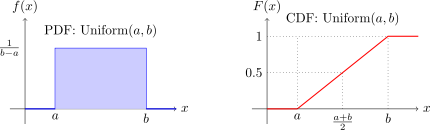
The key insight is that “uniform” means constant density - imagine a perfectly flat rectangle where height never changes.
Deriving the PDF through logical necessity:
Since the distribution is “uniform,” the PDF must be some constant over :
But what is this constant ? We use the fundamental requirement: total probability equals 1.
Therefore:
Example 1:
Consider .
(a) Write down the PDF and sketch it
This creates a rectangle from to with height .
(b) Find
Using the “rectangular property”:
(c) Find
For any continuous distribution: . Individual points have zero probability.
(d) Find
1.2 Cumulative Distribution Function - The Linear Climb
Section titled “1.2 Cumulative Distribution Function - The Linear Climb”Building the CDF step by step:
For , we calculate :
Case 1:
Case 2:
Case 3:
Example 2: CDF Applications
For :
(a) Write down the CDF
(b) Find
(c) Find the first quartile
satisfies :
Example 3: Airport Waiting Times
The waiting times, in minutes, between flight take-offs at an airport are modelled by the continuous random variable with probability density function
- Write down the name of this distribution.
- A randomly selected flight takes off at 9 am. Find the probability that the next flight takes off before 9:05 am.
- Find the probability that at least 1 of the next 5 flights has a waiting time of more than 6 minutes.
- Find the cumulative distribution function of , for all .
- Sketch the cumulative distribution function of for .
1.3 Numerical Characteristics - Mean, Variance, and Transformations
Section titled “1.3 Numerical Characteristics - Mean, Variance, and Transformations”From Rectangle to Balance Point: The Natural Center
Section titled “From Rectangle to Balance Point: The Natural Center”For continuous random variables, we learned that expected value is the “center of gravity.” For uniform distributions, where does this balance point lie?
For :
Beautiful symmetry: The expected value is exactly the midpoint of the interval!
Variance: How Wide is “Wide”?
Section titled “Variance: How Wide is “Wide”?”Using :
Step 1: Calculate
Step 2: Apply the variance formula
Example 4: Parameter Relationships
The continuous random variable is uniformly distributed over the interval where .
Given that :
- Write down an equation involving and .
Given also that :
- Find the value of and the value of .
- Find .
- Find .
Example 5: Kitchen Weighing Scales
Albert uses scales in his kitchen to weigh some fruit. The random variable represents, in grams, the weight of the fruit given by the scales minus the true weight of the fruit. The random variable is uniformly distributed over the interval .
- Specify the probability density function of .
- Find the standard deviation of .
- Albert weighs a banana on the scales. Write down the probability that the weight given by the scales equals the true weight of the banana.
- Find the probability that the weight given by the scales is within 1 gram of the banana’s true weight.
- Albert weighs 10 bananas on the scales, one at a time. Find the probability that the weight given by the scales is within 1 gram of the true weight for at least 6 of the bananas.
Homework Exercises
Section titled “Homework Exercises”Exercise 1: WST02/01/June17/7
The continuous random variable is uniformly distributed over the interval
- Find an expression, in terms of and , for (2)
- Find (2)
Given that
- find an expression, in terms of only, for (3)
Given also that the range of is
- find (2)
Exercise 2: WST02/01/June15/3
A piece of spaghetti has length , where is a positive constant. It is cut into two pieces at a random point. The continuous random variable represents the length of the longer piece and is uniformly distributed over the interval .
- Sketch the graph of the probability density function of (2)
- Use integration to prove that (6)
- Find the probability that the longer piece is more than twice the length of the shorter piece. (3)
Exercise 3: 6684/01/June15/4
The continuous random variable represents the error, in metres, made when a machine cuts poles to a target length. The distribution of is a continuous uniform distribution over the interval
- Find . (1)
- Write down . (1)
- Calculate . (2)
A random sample of poles cut by this machine is taken.
- Find the probability that fewer than poles have an error of more than metres from the target length. (3)
When a new machine cuts poles to a target length, the error, metres, is modelled by the cumulative distribution function where
- Using this model, find (2)
A random sample of poles cut by this new machine is taken.
- Using a suitable approximation, find the probability that at least of these poles have an error of more than metres. (3)
2 Challenge: Buffon’s Needle Experiment
Section titled “2 Challenge: Buffon’s Needle Experiment”The Ultimate Test of Uniform Distribution Theory
Section titled “The Ultimate Test of Uniform Distribution Theory”Now we’ll tackle one of the most famous problems in probability theory - one that beautifully demonstrates how uniform distributions can unlock the secrets of itself.
In 1777, French mathematician Georges-Louis Leclerc, Comte de Buffon, posed this challenge: “What’s the probability that a randomly dropped needle will cross a line on lined paper?”
Step 1: Identify the Random Variables
Section titled “Step 1: Identify the Random Variables”Hint 1: Consider the needle’s position relative to the lines.
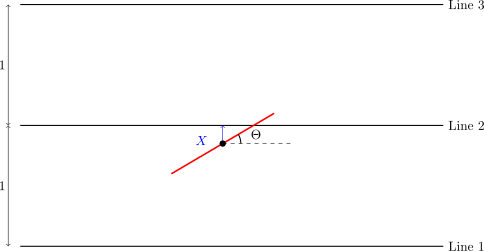
Let be the perpendicular distance from the needle’s center to the nearest line.
Question 1a: The lines are spaced 1 unit apart. What is the range of possible values for (the distance from needle center to nearest line)?
Answer: can range from ____ to ____
Question 1b: If the needle is dropped “randomly,” what distribution should follow?
Hint: Since the needle is dropped randomly, it’s equally likely to land anywhere. This means should be ____ distributed over its range.
Question 1c: Now consider the needle’s orientation. Let be the acute angle between the needle and the parallel lines. What is the range of possible values for ?
Answer: can range from ____ to ____
Question 1d: What distribution should follow?
Hint: Due to rotational symmetry, the needle is equally likely to point in any direction. So should be ____ distributed over its range.
Question 1e: Are and independent?
Think about it: Does the position where the needle lands affect its angle? Does the angle affect where it lands? Your answer: ____
Step 2: Determine the Crossing Condition
Section titled “Step 2: Determine the Crossing Condition”Geometric Analysis: When does the needle cross a line?
Question 2: Look at the diagram. The needle extends unit from its center in each direction. When does the needle cross the nearest line? Find the function such that the needle crosses a line if and only if .
Step 3: Calculate the Probability Using “Averaging”
Section titled “Step 3: Calculate the Probability Using “Averaging””Since we have two random aspects (position and angle ), we need a clever approach. Let’s think step by step:
The Key Insight: For each specific angle , we can easily find the probability that the needle crosses a line. Then we “average” over all possible angles.
Question 3a: Suppose the needle is oriented at a specific angle (where ).
- From Step 2, the needle crosses a line when ____
- Since is uniformly distributed on , what is ?
Let’s work through an example: If , then:
- The needle crosses when
- Since is uniform on :
General formula: ____
Question 3b: Now we need to find the overall probability. Since the angle is also random and uniform on , we need to “average” the conditional probabilities from Question 3a over all possible angles.
Mathematical Averaging: When we have a continuous range of values, “averaging” becomes integration:
Substitute your answer from Question 3a into this formula and evaluate the integral.
Step-by-step guidance:
Step 4: Discover the Amazing Result
Section titled “Step 4: Discover the Amazing Result”Question 4a: Complete the calculation from Step 3. You should get:
Question 4b: Look at your answer! What famous mathematical constant appears? This is the amazing discovery that made Buffon’s needle experiment so famous.
Question 4c: Rearrange your probability formula to express in terms of the crossing probability:
Question 4d: How could you use this experiment to estimate ? If you performed the experiment 1000 times and observed 637 crossings, what would be your estimate for ?
Extension Challenge:
- What happens if the needle length is not equal to the line spacing? Derive the general formula for probability when needle length is and line spacing is .
- If (needle longer than line spacing), how would you modify the analysis?
- Design a classroom experiment using readily available materials (toothpicks, paper, etc.) to estimate .