Taylor series and Maclaurin series provide powerful methods for approximating functions using polynomials. These approximations are fundamental in calculus, engineering, and physics, allowing us to represent complex functions in terms of simpler polynomial expressions.
How can we compute values of functions like e x e^x e x sin x \sin x sin x ln ( 1 + x ) \ln(1+x) ln ( 1 + x )
Taylor series provide a way to represent complicated functions as infinite sums of power terms. This approach not only helps us compute function values but also gives us insights into function behavior near specific points. The Maclaurin series is a special case of the Taylor series centered at x = 0 x = 0 x = 0
For instance, we can represent e x e^x e x 1 + x + x 2 2 ! + x 3 3 ! + … 1 + x + \frac{x^2}{2!} + \frac{x^3}{3!} + \ldots 1 + x + 2 ! x 2 + 3 ! x 3 + …
The development of Taylor series and Maclaurin series represents one of the most significant advancements in mathematical analysis.
Brook Taylor (1685–1731) was an English mathematician who first introduced what we now call Taylor series in his work Methodus Incrementorum Directa et Inversa (1715). Taylor’s method provided a way to express functions as infinite power series, but his presentation lacked the rigor we associate with modern mathematics.
Colin Maclaurin (1698–1746), a Scottish mathematician, popularized the special case of Taylor series centered at x = 0 x = 0 x = 0 Treatise of Fluxions (1742). Although Maclaurin did not discover this special case, his thorough treatment of these series led to them being named after him.
These innovations built upon earlier work by mathematicians like James Gregory and Isaac Newton, who had developed similar ideas but had not formalized them into the general methods we use today.
Taylor series are not merely mathematical curiosities — they are essential tools in modern technology and science:
Satellite Orbit Calculations : NASA and other space agencies use Taylor series expansions to calculate and predict satellite orbits with high precision. The gravitational equations governing orbital mechanics are often too complex to solve exactly, but Taylor approximations provide accurate and computationally efficient solutions.
Computer Calculations : When your calculator or computer evaluates functions like sin x \sin x sin x cos x \cos x cos x e x e^x e x
Notation:
f ′ ( x ) f'(x) f ′ ( x ) f ( 1 ) ( x ) f^{(1)}(x) f ( 1 ) ( x ) f ′ ′ ( x ) f''(x) f ′′ ( x ) f ( 2 ) ( x ) f^{(2)}(x) f ( 2 ) ( x ) f ′ ′ ′ ( x ) f'''(x) f ′′′ ( x ) f ( 3 ) ( x ) f^{(3)}(x) f ( 3 ) ( x ) f ( n ) ( x ) f^{(n)}(x) f ( n ) ( x ) n n n d n f d x n \frac{d^n f}{dx^n} d x n d n f
Examples of Higher Derivative Calculations:
For f ( x ) = e x f(x) = e^x f ( x ) = e x
f ′ ( x ) = e x f ′ ′ ( x ) = e x f ′ ′ ′ ( x ) = e x \begin{aligned}
f'(x) &= e^x \\
f''(x) &= e^x \\
f'''(x) &= e^x
\end{aligned} f ′ ( x ) f ′′ ( x ) f ′′′ ( x ) = e x = e x = e x All derivatives of e x e^x e x e x e^x e x
For f ( x ) = sin x f(x) = \sin x f ( x ) = sin x
f ′ ( x ) = cos x f ′ ′ ( x ) = − sin x f ′ ′ ′ ( x ) = − cos x f ( 4 ) ( x ) = sin x \begin{aligned}
f'(x) &= \cos x \\
f''(x) &= -\sin x \\
f'''(x) &= -\cos x \\
f^{(4)}(x) &= \sin x
\end{aligned} f ′ ( x ) f ′′ ( x ) f ′′′ ( x ) f ( 4 ) ( x ) = cos x = − sin x = − cos x = sin x The derivatives of sin x \sin x sin x
For f ( x ) = x n f(x) = x^n f ( x ) = x n n n n
f ′ ( x ) = n x n − 1 f ′ ′ ( x ) = n ( n − 1 ) x n − 2 f ′ ′ ′ ( x ) = n ( n − 1 ) ( n − 2 ) x n − 3 \begin{aligned}
f'(x) &= nx^{n-1} \\
f''(x) &= n(n-1)x^{n-2} \\
f'''(x) &= n(n-1)(n-2)x^{n-3}
\end{aligned} f ′ ( x ) f ′′ ( x ) f ′′′ ( x ) = n x n − 1 = n ( n − 1 ) x n − 2 = n ( n − 1 ) ( n − 2 ) x n − 3 The pattern continues until we reach the n n n n ! n! n !
Let’s begin by considering a polynomial P ( x ) P(x) P ( x ) f ( x ) f(x) f ( x ) x = 0 x = 0 x = 0
P ( x ) = a 0 + a 1 x + a 2 x 2 + a 3 x 3 + ⋯ + a n x n P(x) = a_0 + a_1x + a_2x^2 + a_3x^3 + \cdots + a_nx^n P ( x ) = a 0 + a 1 x + a 2 x 2 + a 3 x 3 + ⋯ + a n x n If we want this polynomial to match f ( x ) f(x) f ( x ) x = 0 x = 0 x = 0
P ( 0 ) = f ( 0 ) ⇒ a 0 = f ( 0 ) P ′ ( 0 ) = f ′ ( 0 ) ⇒ a 1 = f ′ ( 0 ) P ′ ′ ( 0 ) = f ′ ′ ( 0 ) ⇒ 2 ! a 2 = f ′ ′ ( 0 ) ⇒ a 2 = f ′ ′ ( 0 ) 2 ! P ′ ′ ′ ( 0 ) = f ′ ′ ′ ( 0 ) ⇒ 3 ! a 3 = f ′ ′ ′ ( 0 ) ⇒ a 3 = f ′ ′ ′ ( 0 ) 3 ! \begin{aligned}
P(0) &= f(0) &\Rightarrow \quad a_0 &= f(0) \\
P'(0) &= f'(0) &\Rightarrow \quad a_1 &= f'(0) \\
P''(0) &= f''(0) &\Rightarrow \quad 2!\,a_2 &= f''(0) &\Rightarrow \quad a_2 &= \frac{f''(0)}{2!} \\
P'''(0) &= f'''(0) &\Rightarrow \quad 3!\,a_3 &= f'''(0) &\Rightarrow \quad a_3 &= \frac{f'''(0)}{3!}
\end{aligned} P ( 0 ) P ′ ( 0 ) P ′′ ( 0 ) P ′′′ ( 0 ) = f ( 0 ) = f ′ ( 0 ) = f ′′ ( 0 ) = f ′′′ ( 0 ) ⇒ a 0 ⇒ a 1 ⇒ 2 ! a 2 ⇒ 3 ! a 3 = f ( 0 ) = f ′ ( 0 ) = f ′′ ( 0 ) = f ′′′ ( 0 ) ⇒ a 2 ⇒ a 3 = 2 ! f ′′ ( 0 ) = 3 ! f ′′′ ( 0 ) Continuing this pattern, we find that a n = f ( n ) ( 0 ) n ! a_n = \frac{f^{(n)}(0)}{n!} a n = n ! f ( n ) ( 0 )
Substituting these values into our polynomial:
P ( x ) = f ( 0 ) + f ′ ( 0 ) x + f ′ ′ ( 0 ) 2 ! x 2 + f ′ ′ ′ ( 0 ) 3 ! x 3 + ⋯ + f ( n ) ( 0 ) n ! x n P(x) = f(0) + f'(0)x + \frac{f''(0)}{2!}x^2 + \frac{f'''(0)}{3!}x^3 + \cdots + \frac{f^{(n)}(0)}{n!}x^n P ( x ) = f ( 0 ) + f ′ ( 0 ) x + 2 ! f ′′ ( 0 ) x 2 + 3 ! f ′′′ ( 0 ) x 3 + ⋯ + n ! f ( n ) ( 0 ) x n This is the Maclaurin polynomial of degree n n n n n n Maclaurin series :
f ( x ) = ∑ n = 0 ∞ f ( n ) ( 0 ) n ! x n = f ( 0 ) + f ′ ( 0 ) x + f ′ ′ ( 0 ) 2 ! x 2 + f ′ ′ ′ ( 0 ) 3 ! x 3 + ⋯ f(x) = \sum_{n=0}^{\infty} \frac{f^{(n)}(0)}{n!}x^n = f(0) + f'(0)x + \frac{f''(0)}{2!}x^2 + \frac{f'''(0)}{3!}x^3 + \cdots f ( x ) = n = 0 ∑ ∞ n ! f ( n ) ( 0 ) x n = f ( 0 ) + f ′ ( 0 ) x + 2 ! f ′′ ( 0 ) x 2 + 3 ! f ′′′ ( 0 ) x 3 + ⋯
Problem: Given that y = e 2 x cos ( x ) y = e^{2x}\cos(x) y = e 2 x cos ( x )
(a) Find the first four derivatives of y y y x x x
(b) Determine the Maclaurin series expansion of e 2 x cos ( x ) e^{2x}\cos(x) e 2 x cos ( x ) x 4 x^4 x 4
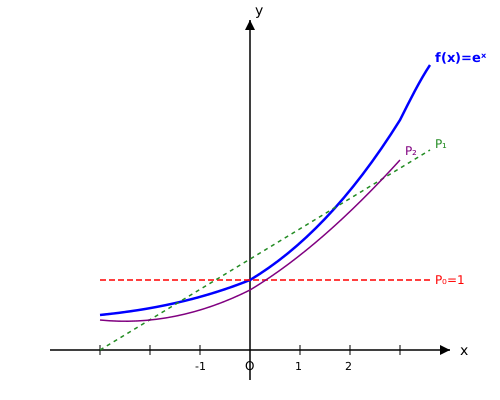
Understanding Maclaurin series becomes much clearer when we visualize how the polynomial approximations converge to the original function.
For example, consider the function f ( x ) = e x f(x) = e^x f ( x ) = e x
P 0 ( x ) = 1 P 1 ( x ) = 1 + x P 2 ( x ) = 1 + x + x 2 2 \begin{aligned}
P_0(x) &= 1 \\
P_1(x) &= 1 + x \\
P_2(x) &= 1 + x + \frac{x^2}{2}
\end{aligned} P 0 ( x ) P 1 ( x ) P 2 ( x ) = 1 = 1 + x = 1 + x + 2 x 2
Observations:
Each polynomial P n ( x ) P_n(x) P n ( x ) f ( x ) f(x) f ( x ) n n n x = 0 x = 0 x = 0
As n n n x x x
Near x = 0 x = 0 x = 0
As we move further from x = 0 x = 0 x = 0
Similar visual patterns emerge for other common functions like sin x \sin x sin x cos x \cos x cos x ln ( 1 + x ) \ln(1+x) ln ( 1 + x )
Problem: Given that y = ln ( 5 + 3 x ) y = \ln(5 + 3x) y = ln ( 5 + 3 x )
(a) Determine, in simplest form, d 3 y d x 3 \displaystyle \frac{d^3y}{dx^3} d x 3 d 3 y
(b) Hence, find the Maclaurin series expansion of ln ( 5 + 3 x ) \ln(5 + 3x) ln ( 5 + 3 x ) x x x x 3 x^3 x 3
Here are the Maclaurin series expansions for some fundamental functions:
Exponential function:
e x = 1 + x + x 2 2 ! + x 3 3 ! + x 4 4 ! + ⋯ = ∑ n = 0 ∞ x n n ! e^x = 1 + x + \frac{x^2}{2!} + \frac{x^3}{3!} + \frac{x^4}{4!} + \cdots = \sum_{n=0}^{\infty} \frac{x^n}{n!} e x = 1 + x + 2 ! x 2 + 3 ! x 3 + 4 ! x 4 + ⋯ = n = 0 ∑ ∞ n ! x n Sine function:
sin x = x − x 3 3 ! + x 5 5 ! − x 7 7 ! + ⋯ = ∑ n = 0 ∞ ( − 1 ) n x 2 n + 1 ( 2 n + 1 ) ! \sin x = x - \frac{x^3}{3!} + \frac{x^5}{5!} - \frac{x^7}{7!} + \cdots = \sum_{n=0}^{\infty} \frac{(-1)^n x^{2n+1}}{(2n+1)!} sin x = x − 3 ! x 3 + 5 ! x 5 − 7 ! x 7 + ⋯ = n = 0 ∑ ∞ ( 2 n + 1 )! ( − 1 ) n x 2 n + 1 Cosine function:
cos x = 1 − x 2 2 ! + x 4 4 ! − x 6 6 ! + ⋯ = ∑ n = 0 ∞ ( − 1 ) n x 2 n ( 2 n ) ! \cos x = 1 - \frac{x^2}{2!} + \frac{x^4}{4!} - \frac{x^6}{6!} + \cdots = \sum_{n=0}^{\infty} \frac{(-1)^n x^{2n}}{(2n)!} cos x = 1 − 2 ! x 2 + 4 ! x 4 − 6 ! x 6 + ⋯ = n = 0 ∑ ∞ ( 2 n )! ( − 1 ) n x 2 n Natural logarithm:
ln ( 1 + x ) = x − x 2 2 + x 3 3 − x 4 4 + ⋯ = ∑ n = 1 ∞ ( − 1 ) n − 1 x n n \ln(1+x) = x - \frac{x^2}{2} + \frac{x^3}{3} - \frac{x^4}{4} + \cdots = \sum_{n=1}^{\infty} \frac{(-1)^{n-1}x^n}{n} ln ( 1 + x ) = x − 2 x 2 + 3 x 3 − 4 x 4 + ⋯ = n = 1 ∑ ∞ n ( − 1 ) n − 1 x n Binomial expansion:
( 1 + x ) k = 1 + k x + k ( k − 1 ) 2 ! x 2 + k ( k − 1 ) ( k − 2 ) 3 ! x 3 + ⋯ (1+x)^k = 1 + kx + \frac{k(k-1)}{2!}x^2 + \frac{k(k-1)(k-2)}{3!}x^3 + \cdots ( 1 + x ) k = 1 + k x + 2 ! k ( k − 1 ) x 2 + 3 ! k ( k − 1 ) ( k − 2 ) x 3 + ⋯ We can calculate the value of e e e e x e^x e x x = 1 x = 1 x = 1
e = e 1 = 1 + 1 + 1 2 ! + 1 3 ! + 1 4 ! + ⋯ e = e^1 = 1 + 1 + \frac{1}{2!} + \frac{1}{3!} + \frac{1}{4!} + \cdots e = e 1 = 1 + 1 + 2 ! 1 + 3 ! 1 + 4 ! 1 + ⋯ Let’s compute increasingly accurate approximations:
1 = 1.0000 1 + 1 = 2.0000 1 + 1 + 1 2 = 2.5000 1 + 1 + 1 2 + 1 6 = 2.6667 1 + 1 + 1 2 + 1 6 + 1 24 = 2.7083 1 + 1 + 1 2 + 1 6 + 1 24 + 1 120 = 2.7167 \begin{aligned}
1 &= 1.0000 \\
1 + 1 &= 2.0000 \\
1 + 1 + \frac{1}{2} &= 2.5000 \\
1 + 1 + \frac{1}{2} + \frac{1}{6} &= 2.6667 \\
1 + 1 + \frac{1}{2} + \frac{1}{6} + \frac{1}{24} &= 2.7083 \\
1 + 1 + \frac{1}{2} + \frac{1}{6} + \frac{1}{24} + \frac{1}{120} &= 2.7167
\end{aligned} 1 1 + 1 1 + 1 + 2 1 1 + 1 + 2 1 + 6 1 1 + 1 + 2 1 + 6 1 + 24 1 1 + 1 + 2 1 + 6 1 + 24 1 + 120 1 = 1.0000 = 2.0000 = 2.5000 = 2.6667 = 2.7083 = 2.7167 The actual value of e e e
We can calculate sin ( 0.1 ) \sin(0.1) sin ( 0.1 )
sin ( 0.1 ) = 0.1 − ( 0.1 ) 3 3 ! + ( 0.1 ) 5 5 ! − ( 0.1 ) 7 7 ! + ⋯ \sin(0.1) = 0.1 - \frac{(0.1)^3}{3!} + \frac{(0.1)^5}{5!} - \frac{(0.1)^7}{7!} + \cdots sin ( 0.1 ) = 0.1 − 3 ! ( 0.1 ) 3 + 5 ! ( 0.1 ) 5 − 7 ! ( 0.1 ) 7 + ⋯ Computing:
0.1 = 0.1000000 0.1 − ( 0.1 ) 3 6 = 0.1 − 0.0001667 = 0.0998333 0.0998333 + ( 0.1 ) 5 120 = 0.0998333 + 0.0000000833 = 0.0998334 \begin{aligned}
0.1 &= 0.1000000 \\
0.1 - \frac{(0.1)^3}{6} &= 0.1 - 0.0001667 = 0.0998333 \\
0.0998333 + \frac{(0.1)^5}{120} &= 0.0998333 + 0.0000000833 = 0.0998334
\end{aligned} 0.1 0.1 − 6 ( 0.1 ) 3 0.0998333 + 120 ( 0.1 ) 5 = 0.1000000 = 0.1 − 0.0001667 = 0.0998333 = 0.0998333 + 0.0000000833 = 0.0998334 The actual value of sin ( 0.1 ) \sin(0.1) sin ( 0.1 ) x x x
Problem: Given the Maclaurin series for ln ( 5 + 3 x ) \ln(5+3x) ln ( 5 + 3 x ) ln ( 5 − 3 x ) \ln(5 - 3x) ln ( 5 − 3 x ) x x x x 3 x^3 x 3 ln ( 5 + 3 x 5 − 3 x ) \ln\left(\frac{5 + 3x}{5 - 3x}\right) ln ( 5 − 3 x 5 + 3 x ) x x x
The Taylor series of a function f ( x ) f(x) f ( x ) x = a x = a x = a
f ( x ) = ∑ n = 0 ∞ f ( n ) ( a ) n ! ( x − a ) n f(x) = \sum_{n=0}^{\infty} \frac{f^{(n)}(a)}{n!}(x-a)^n f ( x ) = n = 0 ∑ ∞ n ! f ( n ) ( a ) ( x − a ) n provided that this infinite series converges to f ( x ) f(x) f ( x ) x x x a a a
The Maclaurin series is simply a special case of the Taylor series where the expansion is centred at a = 0 a = 0 a = 0
When to use Taylor vs. Maclaurin:
Use a Maclaurin series when you’re interested in the behaviour of the function near x = 0 x = 0 x = 0
Use a Taylor series expanded at x = a x = a x = a x = a x = a x = a
A Taylor series often converges more rapidly for values close to its centre point a a a
Example: If we want to approximate ln ( x ) \ln(x) ln ( x ) x = 2 x = 2 x = 2 a = 2 a = 2 a = 2 a = 0 a = 0 a = 0
Problem: Consider the function f ( x ) = sin ( x 2 ) f(x) = \sin(x^2) f ( x ) = sin ( x 2 )
(a) Find the Taylor series expansion of sin ( x 2 ) \sin(x^2) sin ( x 2 ) x = 0 x = 0 x = 0 x 6 x^6 x 6
(b) Find the Taylor series expansion of sin ( x 2 ) \sin(x^2) sin ( x 2 ) x = π / 2 x = \pi/2 x = π /2
Let’s solve the differential equation y ′ ′ + 2 y ′ = x y y'' + 2y' = xy y ′′ + 2 y ′ = x y y ( 1 ) = 1 y(1) = 1 y ( 1 ) = 1 y ′ ( 1 ) = 2 y'(1) = 2 y ′ ( 1 ) = 2
Since our initial conditions are given at x = 1 x = 1 x = 1 x = 1 x = 1 x = 1
y ( x ) = ∑ n = 0 ∞ y ( n ) ( 1 ) n ! ( x − 1 ) n y(x) = \sum_{n=0}^{\infty} \frac{y^{(n)}(1)}{n!} (x-1)^n y ( x ) = n = 0 ∑ ∞ n ! y ( n ) ( 1 ) ( x − 1 ) n Step 1: Initial conditions give us:
y ( 1 ) = y ( 0 ) ( 1 ) = 1 y ′ ( 1 ) = y ( 1 ) ( 1 ) = 2 \begin{aligned}
y(1) &= y^{(0)}(1) = 1 \\
y'(1) &= y^{(1)}(1) = 2
\end{aligned} y ( 1 ) y ′ ( 1 ) = y ( 0 ) ( 1 ) = 1 = y ( 1 ) ( 1 ) = 2 Step 2: By the original equation y ′ ′ + 2 y ′ = x y y'' + 2y' = xy y ′′ + 2 y ′ = x y x = 1 x = 1 x = 1
y ′ ′ ( 1 ) + 2 y ′ ( 1 ) = 1 ⋅ y ( 1 ) y''(1) + 2y'(1) = 1 \cdot y(1) y ′′ ( 1 ) + 2 y ′ ( 1 ) = 1 ⋅ y ( 1 ) Hence y ′ ′ ( 1 ) = 1 ⋅ y ( 1 ) − 2 ⋅ y ′ ( 1 ) = 1 ⋅ 1 − 2 ⋅ 2 = − 3 y''(1) = 1 \cdot y(1) - 2 \cdot y'(1) = 1 \cdot 1 - 2 \cdot 2 = -3 y ′′ ( 1 ) = 1 ⋅ y ( 1 ) − 2 ⋅ y ′ ( 1 ) = 1 ⋅ 1 − 2 ⋅ 2 = − 3
Step 3: Differentiating the original equation, we get:
y ′ ′ ′ + 2 y ′ ′ = y + x y ′ y''' + 2y'' = y + xy' y ′′′ + 2 y ′′ = y + x y ′ Hence y ′ ′ ′ ( 1 ) = y ( 1 ) + 1 ⋅ y ′ ( 1 ) − 2 ⋅ y ′ ′ ( 1 ) = 1 + 1 ⋅ 2 − 2 ⋅ ( − 3 ) = 9 y'''(1) = y(1) + 1 \cdot y'(1) - 2 \cdot y''(1) = 1 + 1 \cdot 2 - 2 \cdot (-3) = 9 y ′′′ ( 1 ) = y ( 1 ) + 1 ⋅ y ′ ( 1 ) − 2 ⋅ y ′′ ( 1 ) = 1 + 1 ⋅ 2 − 2 ⋅ ( − 3 ) = 9
Step 4: Our series solution up to the third order is:
y ( x ) = 1 + 2 ( x − 1 ) − 3 2 ( x − 1 ) 2 + 9 6 ( x − 1 ) 3 = 1 + 2 ( x − 1 ) − 3 2 ( x − 1 ) 2 + 3 2 ( x − 1 ) 3 y(x) = 1 + 2(x-1) - \frac{3}{2}(x-1)^2 + \frac{9}{6}(x-1)^3 = 1 + 2(x-1) - \frac{3}{2}(x-1)^2 + \frac{3}{2}(x-1)^3 y ( x ) = 1 + 2 ( x − 1 ) − 2 3 ( x − 1 ) 2 + 6 9 ( x − 1 ) 3 = 1 + 2 ( x − 1 ) − 2 3 ( x − 1 ) 2 + 2 3 ( x − 1 ) 3
For the differential equation y ′ = x + y y' = x + y y ′ = x + y y ( 0 ) = 1 y(0) = 1 y ( 0 ) = 1 y y y x 3 x^3 x 3
Consider y = sec 2 x y = \sec^2 x y = sec 2 x
(a) Show that d 2 y d x 2 = 6 sec 4 x − 4 sec 2 x \displaystyle \frac{d^2y}{dx^2} = 6\sec^4 x - 4\sec^2 x d x 2 d 2 y = 6 sec 4 x − 4 sec 2 x
(b) Find a Taylor series expansion of sec 2 x \sec^2 x sec 2 x ( x − π 4 ) \displaystyle \left(x - \frac{\pi}{4}\right) ( x − 4 π ) ( x − π 4 ) 3 \displaystyle \left(x - \frac{\pi}{4}\right)^3 ( x − 4 π ) 3
The displacement x x x t t t
d 2 x d t 2 + x + cos x = 0 \frac{d^2x}{dt^2} + x + \cos x = 0 d t 2 d 2 x + x + cos x = 0 When t = 0 t = 0 t = 0 x = 0 x = 0 x = 0 d x d t = 1 2 \frac{dx}{dt} = \frac{1}{2} d t d x = 2 1
Find a Taylor series solution for x x x t t t t 3 t^3 t 3
Consider the differential equation:
d 2 y d x 2 = e y ( 2 y d y d x + y 2 + 1 ) \frac{d^2y}{dx^2} = e^y\left(2y\frac{dy}{dx} + y^2 + 1\right) d x 2 d 2 y = e y ( 2 y d x d y + y 2 + 1 ) (a) Show that
d 3 y d x 3 = e y [ 2 y d 2 y d x 2 + 2 ( d y d x ) 2 + k y d y d x + y 2 + 1 ] \frac{d^3y}{dx^3} = e^y\left[2y\frac{d^2y}{dx^2} + 2\left(\frac{dy}{dx}\right)^2 + ky\frac{dy}{dx} + y^2 + 1\right] d x 3 d 3 y = e y [ 2 y d x 2 d 2 y + 2 ( d x d y ) 2 + k y d x d y + y 2 + 1 ] where k k k
(b) Given that, at x = 0 x = 0 x = 0 y = 1 y = 1 y = 1 d y d x = 2 \frac{dy}{dx} = 2 d x d y = 2 y y y x x x x 3 x^3 x 3
Consider the differential equation:
x d y d x = 3 x + y 2 x\frac{dy}{dx} = 3x + y^2 x d x d y = 3 x + y 2 (a) Show that
x d 2 y d x 2 + ( 1 − 2 y ) d y d x = 3 x\frac{d^2y}{dx^2} + (1-2y)\frac{dy}{dx} = 3 x d x 2 d 2 y + ( 1 − 2 y ) d x d y = 3 (b) Given that y = 1 y = 1 y = 1 x = 1 x = 1 x = 1 y y y ( x − 1 ) (x-1) ( x − 1 ) ( x − 1 ) 3 (x-1)^3 ( x − 1 ) 3