This lecture introduces hyperbolic functions, which arise naturally from certain rational function integrals. These functions share many properties with trigonometric functions but exhibit exponential growth behaviour. We’ll explore their definitions, properties, and applications.
Consider the following integrals that appear frequently in calculus:
∫ d x x 2 ± a 2 \int \frac{dx}{\sqrt{x^2 \pm a^2}} ∫ x 2 ± a 2 d x
These integrals have important applications in physics and engineering, particularly in:
The length of a catenary curve (hanging chain)
The motion of a pendulum
Problems in special relativity
Their solutions lead us naturally to hyperbolic functions.
For any real number x x x
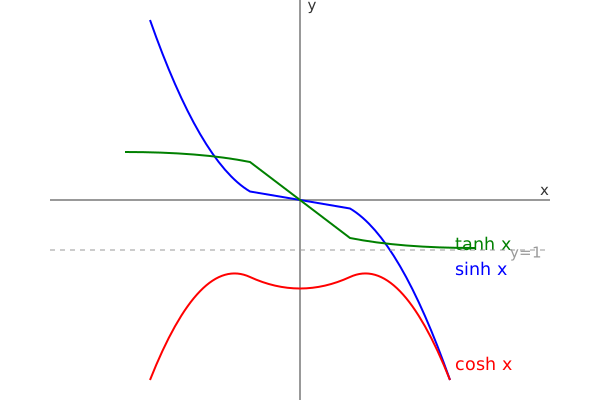
sinh x = e x − e − x 2 (hyperbolic sine) \sinh x = \frac{e^x - e^{-x}}{2} \quad \text{(hyperbolic sine)} sinh x = 2 e x − e − x (hyperbolic sine)
cosh x = e x + e − x 2 (hyperbolic cosine) \cosh x = \frac{e^x + e^{-x}}{2} \quad \text{(hyperbolic cosine)} cosh x = 2 e x + e − x (hyperbolic cosine)
tanh x = sinh x cosh x = e x − e − x e x + e − x (hyperbolic tangent) \tanh x = \frac{\sinh x}{\cosh x} = \frac{e^x - e^{-x}}{e^x + e^{-x}} \quad \text{(hyperbolic tangent)} tanh x = c o s h x s i n h x = e x + e − x e x − e − x (hyperbolic tangent)
Just as trigonometric functions have reciprocal relationships:
sec θ = 1 cos θ , csc θ = 1 sin θ , cot θ = cos θ sin θ \sec \theta = \frac{1}{\cos \theta}, \quad \csc \theta = \frac{1}{\sin \theta}, \quad \cot \theta = \frac{\cos \theta}{\sin \theta} sec θ = c o s θ 1 , csc θ = s i n θ 1 , cot θ = s i n θ c o s θ
derive expressions for their hyperbolic counterparts:
sech x \operatorname{sech} x sech x csch x \operatorname{csch} x csch x coth x \coth x coth x Solution:
sech x = 1 cosh x = 2 e x + e − x \operatorname{sech} x = \dfrac{1}{\cosh x} = \dfrac{2}{e^x + e^{-x}} sech x = cosh x 1 = e x + e − x 2
csch x = 1 sinh x = 2 e x − e − x \operatorname{csch} x = \dfrac{1}{\sinh x} = \dfrac{2}{e^x - e^{-x}} csch x = sinh x 1 = e x − e − x 2
coth x = cosh x sinh x = e x + e − x e x − e − x \coth x = \dfrac{\cosh x}{\sinh x} = \dfrac{e^x + e^{-x}}{e^x - e^{-x}} coth x = sinh x cosh x = e x − e − x e x + e − x
Key Properties:
sech x \operatorname{sech} x sech x 0 < sech x ≤ 1 0 < \operatorname{sech} x \leq 1 0 < sech x ≤ 1 csch x \operatorname{csch} x csch x x = 0 x = 0 x = 0 coth x \coth x coth x x = 0 x = 0 x = 0 ∣ coth x ∣ > 1 |\coth x| > 1 ∣ coth x ∣ > 1 x ≠ 0 x \neq 0 x = 0
cosh x ≥ 1 \cosh x \geq 1 cosh x ≥ 1 x x x sinh x \sinh x sinh x sinh ( − x ) = − sinh ( x ) \sinh(-x) = -\sinh(x) sinh ( − x ) = − sinh ( x ) cosh x \cosh x cosh x cosh ( − x ) = cosh ( x ) \cosh(-x) = \cosh(x) cosh ( − x ) = cosh ( x )
sinh x \sinh x sinh x sin x \sin x sin x ∣ x ∣ → ∞ |x| \to \infty ∣ x ∣ → ∞ cosh x \cosh x cosh x cos x \cos x cos x tanh x \tanh x tanh x y = ± 1 y = \pm 1 y = ± 1
Step 1. Using the definition:
e x − e − x 2 = 3 \frac{e^x - e^{-x}}{2} = 3 2 e x − e − x = 3
Step 2. Let y = e x y = e^x y = e x e − x = 1 y e^{-x} = \dfrac{1}{y} e − x = y 1
y − 1 y = 6 y - \frac{1}{y} = 6 y − y 1 = 6
Step 3. Rearrange to standard form:
y 2 − 6 y − 1 = 0 y^2 - 6y - 1 = 0 y 2 − 6 y − 1 = 0
Step 4. Solve quadratic equation:
y = 6 ± 36 + 4 2 = 3 ± 10 y = \frac{6 \pm \sqrt{36 + 4}}{2} = 3 \pm \sqrt{10} y = 2 6 ± 36 + 4 = 3 ± 10
Step 5. Since y = e x y = e^x y = e x y > 0 y > 0 y > 0
x = ln ( 3 + 10 ) x = \ln(3 + \sqrt{10}) x = ln ( 3 + 10 )
The curve C 1 C_1 C 1 y = 3 sinh 2 x y = 3\sinh 2x y = 3 sinh 2 x C 2 C_2 C 2 y = 13 − 3 e 2 x y = 13 - 3e^{2x} y = 13 − 3 e 2 x
(a) Sketch the graphs of curves C 1 C_1 C 1 C 2 C_2 C 2
(b) Hence solve the equation 3 sinh 2 x = 13 − 3 e 2 x 3\sinh 2x = 13 - 3e^{2x} 3 sinh 2 x = 13 − 3 e 2 x 1 2 ln k \frac{1}{2}\ln k 2 1 ln k k k k
Solution:
(a) For curve C 1 : y = 3 sinh 2 x C_1: y = 3\sinh 2x C 1 : y = 3 sinh 2 x
When x = 0 x = 0 x = 0 y = 0 y = 0 y = 0 ( 0 , 0 ) (0,0) ( 0 , 0 )
As x → ∞ x \to \infty x → ∞ y → ∞ y \to \infty y → ∞
As x → − ∞ x \to -\infty x → − ∞ y → − ∞ y \to -\infty y → − ∞
Odd function, symmetric about origin
For curve C 2 : y = 13 − 3 e 2 x C_2: y = 13 - 3e^{2x} C 2 : y = 13 − 3 e 2 x
When x = 0 x = 0 x = 0 y = 13 − 3 = 10 y = 13 - 3 = 10 y = 13 − 3 = 10 ( 0 , 10 ) (0,10) ( 0 , 10 )
As x → ∞ x \to \infty x → ∞ y → − ∞ y \to -\infty y → − ∞
As x → − ∞ x \to -\infty x → − ∞ y → 13 y \to 13 y → 13
Crosses y y y ( 0 , 10 ) (0,10) ( 0 , 10 )
(b) Using the definition of sinh x \sinh x sinh x
3 sinh 2 x = 13 − 3 e 2 x 3\sinh 2x = 13 - 3e^{2x} 3 sinh 2 x = 13 − 3 e 2 x
3 ( e 2 x − e − 2 x 2 ) = 13 − 3 e 2 x 3\left(\frac{e^{2x} - e^{-2x}}{2}\right) = 13 - 3e^{2x} 3 ( 2 e 2 x − e − 2 x ) = 13 − 3 e 2 x
3 e 2 x − 3 e − 2 x 2 = 13 − 3 e 2 x \frac{3e^{2x} - 3e^{-2x}}{2} = 13 - 3e^{2x} 2 3 e 2 x − 3 e − 2 x = 13 − 3 e 2 x
3 e 2 x − 3 e − 2 x = 26 − 6 e 2 x 3e^{2x} - 3e^{-2x} = 26 - 6e^{2x} 3 e 2 x − 3 e − 2 x = 26 − 6 e 2 x
9 e 2 x − 3 e − 2 x = 26 9e^{2x} - 3e^{-2x} = 26 9 e 2 x − 3 e − 2 x = 26
9 e 4 x − 3 = 26 e 2 x 9e^{4x} - 3 = 26e^{2x} 9 e 4 x − 3 = 26 e 2 x
9 e 4 x − 26 e 2 x − 3 = 0 9e^{4x} - 26e^{2x} - 3 = 0 9 e 4 x − 26 e 2 x − 3 = 0
Let y = e 2 x y = e^{2x} y = e 2 x
9 y 2 − 26 y − 3 = 0 ⇒ ( 3 y − 1 ) ( 3 y + 3 ) = 0 9y^2 - 26y - 3 = 0 \Rightarrow (3y-1)(3y+3) = 0 9 y 2 − 26 y − 3 = 0 ⇒ ( 3 y − 1 ) ( 3 y + 3 ) = 0
Therefore y = 1 3 y = \dfrac{1}{3} y = 3 1 y = − 1 y = -1 y = − 1
Since y = e 2 x > 0 y = e^{2x} > 0 y = e 2 x > 0 y = 1 3 y = \dfrac{1}{3} y = 3 1
Hence e 2 x = 1 3 e^{2x} = \dfrac{1}{3} e 2 x = 3 1 x = 1 2 ln ( 1 3 ) = − 1 2 ln 3 x = \dfrac{1}{2}\ln\!\left(\dfrac{1}{3}\right) = -\dfrac{1}{2}\ln 3 x = 2 1 ln ( 3 1 ) = − 2 1 ln 3
To find the domain of an inverse function:
Check if the original function is one-to-one (injective)
If not, restrict the domain to make it one-to-one
The range of the original function becomes the domain of the inverse function
The domain of the original function becomes the range of the inverse function
For example, cosh x \cosh x cosh x [ 0 , ∞ ) [0,\infty) [ 0 , ∞ ) cosh − 1 \cosh^{-1} cosh − 1
For each of the six hyperbolic functions, determine:
Whether the function is one-to-one on R \mathbb{R} R
If not, what domain restriction is needed
The domain of its inverse function
Function One-to-one? Restriction needed Domain of inverse sinh x \sinh x sinh x Yes None − ∞ < x < ∞ -\infty < x < \infty − ∞ < x < ∞ cosh x \cosh x cosh x No (even) x ≥ 0 x \geq 0 x ≥ 0 x ≥ 1 x \geq 1 x ≥ 1 tanh x \tanh x tanh x Yes None − 1 < x < 1 -1 < x < 1 − 1 < x < 1 sech x \operatorname{sech} x sech x No (even) x ≥ 0 x \geq 0 x ≥ 0 0 < x ≤ 1 0 < x \leq 1 0 < x ≤ 1 csch x \operatorname{csch} x csch x No (asymptote) x < 0 x < 0 x < 0 x > 0 x > 0 x > 0 x ≠ 0 x \neq 0 x = 0 coth x \coth x coth x No (asymptote) x < 0 x < 0 x < 0 x > 0 x > 0 x > 0 x < − 1 x < -1 x < − 1 x > 1 x > 1 x > 1
Explanation:
sinh x \sinh x sinh x x ∈ R x \in \mathbb{R} x ∈ R cosh x \cosh x cosh x x ≥ 0 x \geq 0 x ≥ 0 tanh x \tanh x tanh x y = ± 1 y = \pm 1 y = ± 1 sech x \operatorname{sech} x sech x x ≥ 0 x \geq 0 x ≥ 0 0 < y ≤ 1 0 < y \leq 1 0 < y ≤ 1 csch x \operatorname{csch} x csch x x = 0 x = 0 x = 0 x < 0 x < 0 x < 0 x > 0 x > 0 x > 0 coth x \coth x coth x x = 0 x = 0 x = 0 y = ± 1 y = \pm 1 y = ± 1
For appropriate domains:
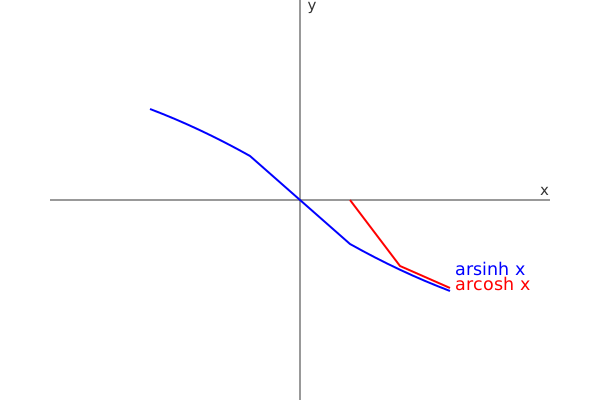
sinh − 1 x = ln ( x + x 2 + 1 ) \sinh^{-1} x = \ln(x + \sqrt{x^2 + 1}) sinh − 1 x = ln ( x + x 2 + 1 )
cosh − 1 x = ln ( x + x 2 − 1 ) , x ≥ 1 \cosh^{-1} x = \ln(x + \sqrt{x^2 - 1}), \quad x \geq 1 cosh − 1 x = ln ( x + x 2 − 1 ) , x ≥ 1
tanh − 1 x = 1 2 ln ( 1 + x 1 − x ) , ∣ x ∣ < 1 \tanh^{-1} x = \frac{1}{2}\ln\!\left(\frac{1+x}{1-x}\right), \quad |x| < 1 tanh − 1 x = 2 1 ln ( 1 − x 1 + x ) , ∣ x ∣ < 1
For any real x x x
cosh x = cos ( i x ) \cosh x = \cos(ix) cosh x = cos ( i x )
sinh x = − i sin ( i x ) \sinh x = -i\sin(ix) sinh x = − i sin ( i x )
Using the relationship between hyperbolic and trigonometric functions, prove that:
cosh 2 x − sinh 2 x = 1 \cosh^2 x - \sinh^2 x = 1 cosh 2 x − sinh 2 x = 1
given that cos 2 θ + sin 2 θ = 1 \cos^2 \theta + \sin^2 \theta = 1 cos 2 θ + sin 2 θ = 1
Solution:
cosh 2 x − sinh 2 x = [ cos ( i x ) ] 2 − [ − i sin ( i x ) ] 2 \cosh^2 x - \sinh^2 x = [\cos(ix)]^2 - [-i\sin(ix)]^2 cosh 2 x − sinh 2 x = [ cos ( i x ) ] 2 − [ − i sin ( i x ) ] 2
= cos 2 ( i x ) + sin 2 ( i x ) = \cos^2(ix) + \sin^2(ix) = cos 2 ( i x ) + sin 2 ( i x )
= 1 = 1 = 1
Using the relationship with trigonometric functions, derive the addition formula for hyperbolic functions:
sinh ( x + y ) = sinh x cosh y + cosh x sinh y \sinh(x+y) = \sinh x \cosh y + \cosh x \sinh y sinh ( x + y ) = sinh x cosh y + cosh x sinh y
given that sin ( A + B ) = sin A cos B + cos A sin B \sin(A+B) = \sin A \cos B + \cos A \sin B sin ( A + B ) = sin A cos B + cos A sin B
Solution:
sinh ( x + y ) = − i sin [ i ( x + y ) ] \sinh(x+y) = -i\sin[i(x+y)] sinh ( x + y ) = − i sin [ i ( x + y )]
= − i sin ( i x + i y ) = -i\sin(ix+iy) = − i sin ( i x + i y )
= − i [ sin ( i x ) cos ( i y ) + cos ( i x ) sin ( i y ) ] = -i[\sin(ix)\cos(iy) + \cos(ix)\sin(iy)] = − i [ sin ( i x ) cos ( i y ) + cos ( i x ) sin ( i y )]
= − i [ i sinh x cosh y + cosh x ⋅ i sinh y ] = -i[i\sinh x \cosh y + \cosh x \cdot i\sinh y] = − i [ i sinh x cosh y + cosh x ⋅ i sinh y ]
= sinh x cosh y + cosh x sinh y = \sinh x \cosh y + \cosh x \sinh y = sinh x cosh y + cosh x sinh y
1. Addition Formulas:
sinh ( x + y ) = sinh x cosh y + cosh x sinh y \sinh(x+y) = \sinh x \cosh y + \cosh x \sinh y sinh ( x + y ) = sinh x cosh y + cosh x sinh y
cosh ( x + y ) = cosh x cosh y + sinh x sinh y \cosh(x+y) = \cosh x \cosh y + \sinh x \sinh y cosh ( x + y ) = cosh x cosh y + sinh x sinh y
2. Double Angle Formulas:
sinh ( 2 x ) = 2 sinh x cosh x \sinh(2x) = 2\sinh x \cosh x sinh ( 2 x ) = 2 sinh x cosh x
cosh ( 2 x ) = cosh 2 x + sinh 2 x = 2 cosh 2 x − 1 \cosh(2x) = \cosh^2 x + \sinh^2 x = 2\cosh^2 x - 1 cosh ( 2 x ) = cosh 2 x + sinh 2 x = 2 cosh 2 x − 1
3. Pythagorean-like Identities:
1 − tanh 2 x = sech 2 x (dividing fundamental identity by cosh 2 x ) 1 - \tanh^2 x = \operatorname{sech}^2 x \quad \text{(dividing fundamental identity by } \cosh^2 x\text{)} 1 − tanh 2 x = sech 2 x (dividing fundamental identity by cosh 2 x )
coth 2 x − 1 = csch 2 x (dividing fundamental identity by sinh 2 x ) \coth^2 x - 1 = \operatorname{csch}^2 x \quad \text{(dividing fundamental identity by } \sinh^2 x\text{)} coth 2 x − 1 = csch 2 x (dividing fundamental identity by sinh 2 x )
Use the addition formula for sinh ( x + y ) \sinh(x+y) sinh ( x + y )
sinh ( 2 x ) = 2 sinh x cosh x \sinh(2x) = 2\sinh x \cosh x sinh ( 2 x ) = 2 sinh x cosh x
Solution:
Let y = x y = x y = x
sinh ( 2 x ) = sinh ( x + x ) \sinh(2x) = \sinh(x+x) sinh ( 2 x ) = sinh ( x + x )
= sinh x cosh x + cosh x sinh x = \sinh x \cosh x + \cosh x \sinh x = sinh x cosh x + cosh x sinh x
= 2 sinh x cosh x = 2\sinh x \cosh x = 2 sinh x cosh x
Don’t confuse hyperbolic functions with their trigonometric counterparts
Remember that cosh x ≥ 1 \cosh x \geq 1 cosh x ≥ 1 x x x
Pay attention to domain restrictions, especially for inverse functions
Be careful with signs when using complex relationships
Watch out for the differences between hyperbolic and trigonometric identities
Solve the equation:
7 sech x − tanh x = 5 7\operatorname{sech} x - \tanh x = 5 7 sech x − tanh x = 5
Give your answers in the form ln a \ln a ln a a a a
Solution:
Method 1: Using the definitions
7 cosh x − sinh x cosh x = 5 \frac{7}{\cosh x} - \frac{\sinh x}{\cosh x} = 5 c o s h x 7 − c o s h x s i n h x = 5
7 − sinh x cosh x = 5 \frac{7 - \sinh x}{\cosh x} = 5 c o s h x 7 − s i n h x = 5
7 − sinh x = 5 cosh x 7 - \sinh x = 5\cosh x 7 − sinh x = 5 cosh x
7 − e x − e − x 2 = 5 e x + e − x 2 7 - \frac{e^x - e^{-x}}{2} = 5\frac{e^x + e^{-x}}{2} 7 − 2 e x − e − x = 5 2 e x + e − x
14 − ( e x − e − x ) = 5 ( e x + e − x ) 14 - (e^x - e^{-x}) = 5(e^x + e^{-x}) 14 − ( e x − e − x ) = 5 ( e x + e − x )
14 − e x + e − x = 5 e x + 5 e − x 14 - e^x + e^{-x} = 5e^x + 5e^{-x} 14 − e x + e − x = 5 e x + 5 e − x
14 − 6 e x − 4 e − x = 0 14 - 6e^x - 4e^{-x} = 0 14 − 6 e x − 4 e − x = 0
3 e 2 x − 7 e x + 2 = 0 3e^{2x} - 7e^x + 2 = 0 3 e 2 x − 7 e x + 2 = 0
Let y = e x y = e^x y = e x
3 y 2 − 7 y + 2 = 0 ⇒ ( 3 y − 1 ) ( y − 2 ) = 0 3y^2 - 7y + 2 = 0 \Rightarrow (3y-1)(y-2) = 0 3 y 2 − 7 y + 2 = 0 ⇒ ( 3 y − 1 ) ( y − 2 ) = 0
Therefore y = 1 3 y = \dfrac{1}{3} y = 3 1 y = 2 y = 2 y = 2
Hence x = ln ( 1 3 ) x = \ln\!\left(\dfrac{1}{3}\right) x = ln ( 3 1 ) x = ln 2 x = \ln 2 x = ln 2
Method 2: Using sech 2 x + tanh 2 x = 1 \operatorname{sech}^2 x + \tanh^2 x = 1 sech 2 x + tanh 2 x = 1
( 7 sech x − 5 ) 2 = tanh 2 x (7\operatorname{sech} x - 5)^2 = \tanh^2 x ( 7 sech x − 5 ) 2 = tanh 2 x
49 sech 2 x − 70 sech x + 25 = 1 − sech 2 x 49\operatorname{sech}^2 x - 70\operatorname{sech} x + 25 = 1 - \operatorname{sech}^2 x 49 sech 2 x − 70 sech x + 25 = 1 − sech 2 x
50 sech 2 x − 70 sech x + 24 = 0 50\operatorname{sech}^2 x - 70\operatorname{sech} x + 24 = 0 50 sech 2 x − 70 sech x + 24 = 0
2 ( 5 sech x − 3 ) ( 5 sech x − 4 ) = 0 2(5\operatorname{sech} x - 3)(5\operatorname{sech} x - 4) = 0 2 ( 5 sech x − 3 ) ( 5 sech x − 4 ) = 0
sech x = 3 5 or 4 5 \operatorname{sech} x = \frac{3}{5} \text{ or } \frac{4}{5} sech x = 5 3 or 5 4
Leading to the same answers.
(a) Starting from the definitions of sinh x \sinh x sinh x cosh x \cosh x cosh x
cosh 2 x = 1 + 2 sinh 2 x \cosh 2x = 1 + 2\sinh^2 x cosh 2 x = 1 + 2 sinh 2 x
Solution:
RHS = 1 + 2 sinh 2 x = 1 + 2 ( e x − e − x 2 ) 2 \text{RHS} = 1 + 2\sinh^2 x = 1 + 2\left(\frac{e^x - e^{-x}}{2}\right)^2 RHS = 1 + 2 sinh 2 x = 1 + 2 ( 2 e x − e − x ) 2
= 1 + 2 ( e 2 x − 2 + e − 2 x 4 ) = 1 + 2\left(\frac{e^{2x} - 2 + e^{-2x}}{4}\right) = 1 + 2 ( 4 e 2 x − 2 + e − 2 x )
= 1 + e 2 x − 2 + e − 2 x 2 = 1 + \frac{e^{2x} - 2 + e^{-2x}}{2} = 1 + 2 e 2 x − 2 + e − 2 x
= 2 + e 2 x − 2 + e − 2 x 2 = \frac{2 + e^{2x} - 2 + e^{-2x}}{2} = 2 2 + e 2 x − 2 + e − 2 x
= e 2 x + e − 2 x 2 = \frac{e^{2x} + e^{-2x}}{2} = 2 e 2 x + e − 2 x
= cosh 2 x = LHS = \cosh 2x = \text{LHS} = cosh 2 x = LHS
(b) Solve the equation:
cosh 2 x − 3 sinh x = 15 \cosh 2x - 3\sinh x = 15 cosh 2 x − 3 sinh x = 15
giving your answers as exact logarithms.
Solution:
Using part (a):
1 + 2 sinh 2 x − 3 sinh x = 15 1 + 2\sinh^2 x - 3\sinh x = 15 1 + 2 sinh 2 x − 3 sinh x = 15
Rearrange:
2 sinh 2 x − 3 sinh x − 14 = 0 2\sinh^2 x - 3\sinh x - 14 = 0 2 sinh 2 x − 3 sinh x − 14 = 0
Factorise:
( sinh x + 2 ) ( 2 sinh x − 7 ) = 0 (\sinh x + 2)(2\sinh x - 7) = 0 ( sinh x + 2 ) ( 2 sinh x − 7 ) = 0
Therefore:
sinh x = − 2 or sinh x = 7 2 \sinh x = -2 \text{ or } \sinh x = \frac{7}{2} sinh x = − 2 or sinh x = 2 7
For sinh x = − 2 \sinh x = -2 sinh x = − 2
x = ln ( − 2 + ( − 2 ) 2 + 1 ) = ln ( − 2 + 5 ) x = \ln(-2 + \sqrt{(-2)^2 + 1}) = \ln(-2 + \sqrt{5}) x = ln ( − 2 + ( − 2 ) 2 + 1 ) = ln ( − 2 + 5 )
For sinh x = 7 2 \sinh x = \dfrac{7}{2} sinh x = 2 7
x = ln ( 7 2 + ( 7 2 ) 2 + 1 ) = ln ( 7 + 53 2 ) x = \ln\!\left(\frac{7}{2} + \sqrt{\left(\frac{7}{2}\right)^2 + 1}\right) = \ln\!\left(\frac{7 + \sqrt{53}}{2}\right) x = ln ( 2 7 + ( 2 7 ) 2 + 1 ) = ln ( 2 7 + 53 )
Solve the equation:
5 tanh x + 7 = 5 sech x 5\tanh x + 7 = 5\operatorname{sech} x 5 tanh x + 7 = 5 sech x
Give each answer in the form ln k \ln k ln k k k k
Solution:
Method 1: Using exponential definitions
5 e x − e − x e x + e − x + 7 = 10 e x + e − x 5\frac{e^x - e^{-x}}{e^x + e^{-x}} + 7 = \frac{10}{e^x + e^{-x}} 5 e x + e − x e x − e − x + 7 = e x + e − x 10
5 ( e x − e − x ) + 7 ( e x + e − x ) = 10 5(e^x - e^{-x}) + 7(e^x + e^{-x}) = 10 5 ( e x − e − x ) + 7 ( e x + e − x ) = 10
5 e x − 5 e − x + 7 e x + 7 e − x = 10 5e^x - 5e^{-x} + 7e^x + 7e^{-x} = 10 5 e x − 5 e − x + 7 e x + 7 e − x = 10
12 e x + 2 e − x = 10 12e^x + 2e^{-x} = 10 12 e x + 2 e − x = 10
6 e 2 x − 5 e x + 1 = 0 6e^{2x} - 5e^x + 1 = 0 6 e 2 x − 5 e x + 1 = 0
Let y = e x y = e^x y = e x
6 y 2 − 5 y + 1 = 0 ⇒ ( 3 y − 1 ) ( 2 y − 1 ) = 0 6y^2 - 5y + 1 = 0 \Rightarrow (3y-1)(2y-1) = 0 6 y 2 − 5 y + 1 = 0 ⇒ ( 3 y − 1 ) ( 2 y − 1 ) = 0
Therefore y = 1 3 y = \dfrac{1}{3} y = 3 1 y = 1 2 y = \dfrac{1}{2} y = 2 1
Hence x = ln ( 1 3 ) x = \ln\!\left(\dfrac{1}{3}\right) x = ln ( 3 1 ) x = ln ( 1 2 ) x = \ln\!\left(\dfrac{1}{2}\right) x = ln ( 2 1 )
Method 2: Using tanh 2 x + sech 2 x = 1 \tanh^2 x + \operatorname{sech}^2 x = 1 tanh 2 x + sech 2 x = 1
5 tanh x + 7 = 5 sech x 5\tanh x + 7 = 5\operatorname{sech} x 5 tanh x + 7 = 5 sech x
5 tanh x − 5 sech x = − 7 5\tanh x - 5\operatorname{sech} x = -7 5 tanh x − 5 sech x = − 7
25 tanh 2 x + 70 tanh x + 49 = 25 sech 2 x 25\tanh^2 x + 70\tanh x + 49 = 25\operatorname{sech}^2 x 25 tanh 2 x + 70 tanh x + 49 = 25 sech 2 x
25 tanh 2 x + 70 tanh x + 49 = 25 ( 1 − tanh 2 x ) 25\tanh^2 x + 70\tanh x + 49 = 25(1-\tanh^2 x) 25 tanh 2 x + 70 tanh x + 49 = 25 ( 1 − tanh 2 x )
50 tanh 2 x + 70 tanh x + 24 = 0 50\tanh^2 x + 70\tanh x + 24 = 0 50 tanh 2 x + 70 tanh x + 24 = 0
2 ( 5 tanh x + 3 ) ( 5 tanh x + 4 ) = 0 2(5\tanh x + 3)(5\tanh x + 4) = 0 2 ( 5 tanh x + 3 ) ( 5 tanh x + 4 ) = 0
tanh x = − 3 5 or − 4 5 \tanh x = -\frac{3}{5} \text{ or } -\frac{4}{5} tanh x = − 5 3 or − 5 4
Using tanh x = e x − e − x e x + e − x = − 4 5 \tanh x = \dfrac{e^x - e^{-x}}{e^x + e^{-x}} = -\dfrac{4}{5} tanh x = e x + e − x e x − e − x = − 5 4
e x − e − x e x + e − x = − 4 5 ⇒ e x = 1 2 ⇒ x = ln ( 1 2 ) \frac{e^x - e^{-x}}{e^x + e^{-x}} = -\frac{4}{5} \Rightarrow e^x = \frac{1}{2} \Rightarrow x = \ln\!\left(\frac{1}{2}\right) e x + e − x e x − e − x = − 5 4 ⇒ e x = 2 1 ⇒ x = ln ( 2 1 )
Similarly for tanh x = − 3 5 \tanh x = -\dfrac{3}{5} tanh x = − 5 3
e x − e − x e x + e − x = − 3 5 ⇒ e x = 1 3 ⇒ x = ln ( 1 3 ) \frac{e^x - e^{-x}}{e^x + e^{-x}} = -\frac{3}{5} \Rightarrow e^x = \frac{1}{3} \Rightarrow x = \ln\!\left(\frac{1}{3}\right) e x + e − x e x − e − x = − 5 3 ⇒ e x = 3 1 ⇒ x = ln ( 3 1 )
Method 3: Using sinh x \sinh x sinh x cosh x \cosh x cosh x
5 sinh x + 7 cosh x = 5 5\sinh x + 7\cosh x = 5 5 sinh x + 7 cosh x = 5
5 sinh x + 7 cosh x − 5 = 0 5\sinh x + 7\cosh x - 5 = 0 5 sinh x + 7 cosh x − 5 = 0
24 sinh 2 x + 50 sinh x + 24 = 0 24\sinh^2 x + 50\sinh x + 24 = 0 24 sinh 2 x + 50 sinh x + 24 = 0
sinh x = − 4 3 or − 3 4 \sinh x = -\frac{4}{3} \text{ or } -\frac{3}{4} sinh x = − 3 4 or − 4 3
Using sinh x = e x − e − x 2 \sinh x = \dfrac{e^x - e^{-x}}{2} sinh x = 2 e x − e − x
e x − e − x 2 = − 4 3 ⇒ e x = 1 3 or 1 2 \frac{e^x - e^{-x}}{2} = -\frac{4}{3} \Rightarrow e^x = \frac{1}{3} \text{ or } \frac{1}{2} 2 e x − e − x = − 3 4 ⇒ e x = 3 1 or 2 1
Leading to the same answers.
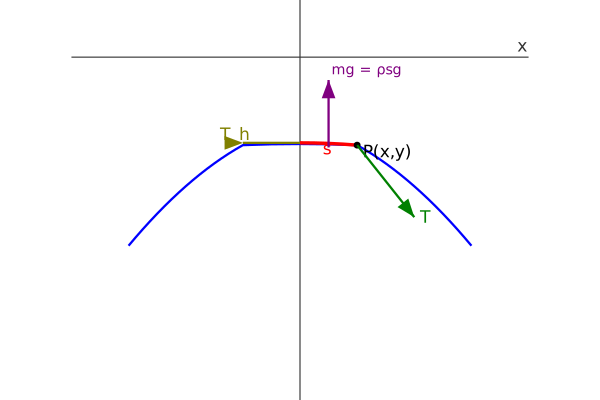
Consider a flexible chain hanging under its own weight. We’ll derive its shape — the famous catenary curve y = a cosh ( x a ) y = a\cosh\!\left(\dfrac{x}{a}\right) y = a cosh ( a x )
Let’s establish our coordinate system:
x x x y y y ρ \rho ρ s s s P ( x , y ) P(x,y) P ( x , y ) T T T P P P T h T_h T h
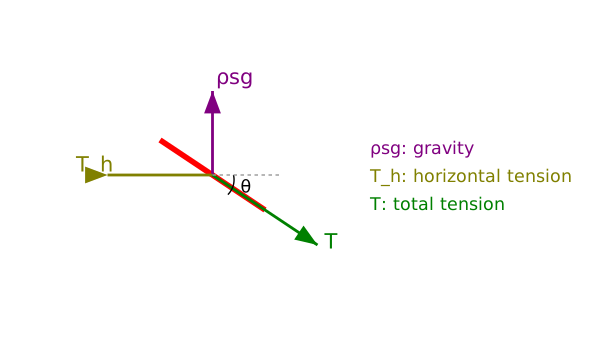
For a small segment of the chain:
Mass of segment = ρ s \rho s ρ s
Tension T T T
T h T_h T h θ \theta θ T T T
From the force balance:
T sin θ = ρ s g (vertical force balance) T\sin\theta = \rho s g \quad \text{(vertical force balance)} T sin θ = ρ s g (vertical force balance)
T cos θ = T h (horizontal force balance) T\cos\theta = T_h \quad \text{(horizontal force balance)} T cos θ = T h (horizontal force balance)
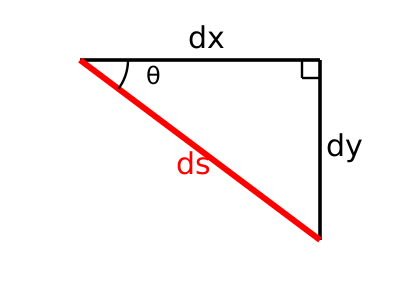
For a small segment:
sin θ = d y d s \sin\theta = \frac{dy}{ds} sin θ = d s d y
cos θ = d x d s \cos\theta = \frac{dx}{ds} cos θ = d s d x
Dividing the force equations:
tan θ = ρ s g T h = d y d x \tan\theta = \frac{\rho s g}{T_h} = \frac{dy}{dx} tan θ = T h ρ s g = d x d y
Let a = T h ρ g a = \dfrac{T_h}{\rho g} a = ρ g T h
d y d x = s a \frac{dy}{dx} = \frac{s}{a} d x d y = a s
From the differential triangle:
d s 2 = d x 2 + d y 2 therefore d s d x = 1 + ( d y d x ) 2 ds^2 = dx^2 + dy^2 \quad \text{therefore} \quad \frac{ds}{dx} = \sqrt{1 + \left(\frac{dy}{dx}\right)^2} d s 2 = d x 2 + d y 2 therefore d x d s = 1 + ( d x d y ) 2
Differentiating d y d x = s a \dfrac{dy}{dx} = \dfrac{s}{a} d x d y = a s x x x
d 2 y d x 2 = 1 a d s d x = 1 a 1 + ( d y d x ) 2 \frac{d^2y}{dx^2} = \frac{1}{a}\frac{ds}{dx} = \frac{1}{a}\sqrt{1 + \left(\frac{dy}{dx}\right)^2} d x 2 d 2 y = a 1 d x d s = a 1 1 + ( d x d y ) 2
We have derived the differential equation:
d 2 y d x 2 = 1 a 1 + ( d y d x ) 2 \frac{d^2y}{dx^2} = \frac{1}{a}\sqrt{1 + \left(\frac{dy}{dx}\right)^2} d x 2 d 2 y = a 1 1 + ( d x d y ) 2
Question: Try to solve this equation with the following hints:
Substitute d y d x \dfrac{dy}{dx} d x d y p p p
The derivative of arsinh ( p ) \operatorname{arsinh}(p) arsinh ( p ) 1 1 + p 2 \dfrac{1}{\sqrt{1 + p^2}} 1 + p 2 1 arsinh ( p ) \operatorname{arsinh}(p) arsinh ( p )
The derivative of sinh ( x ) \sinh(x) sinh ( x ) cosh ( x ) \cosh(x) cosh ( x ) sinh ( x ) \sinh(x) sinh ( x ) cosh ( x ) \cosh(x) cosh ( x )
Solution:
Using the hint about arsinh ( p ) \operatorname{arsinh}(p) arsinh ( p )
arsinh ( p ) = x a + C 1 \operatorname{arsinh}(p) = \frac{x}{a} + C_1 arsinh ( p ) = a x + C 1
Therefore:
p = sinh ( x a + C 1 ) p = \sinh\!\left(\frac{x}{a} + C_1\right) p = sinh ( a x + C 1 )
Since p = d y d x p = \dfrac{dy}{dx} p = d x d y C 1 C_1 C 1
d y d x = sinh ( x a ) \frac{dy}{dx} = \sinh\!\left(\frac{x}{a}\right) d x d y = sinh ( a x )
Integrating again:
y = a cosh ( x a ) + C 2 y = a\cosh\!\left(\frac{x}{a}\right) + C_2 y = a cosh ( a x ) + C 2
This is the general equation of a catenary curve, where:
a a a C 2 C_2 C 2
Prove that the tension at any point is:
T = T h cosh ( x a ) T = T_h\cosh\!\left(\frac{x}{a}\right) T = T h cosh ( a x )
Research: Why do suspension bridges follow a parabolic shape instead of a catenary? (Hint: Consider how the load is distributed)
It is important to highlight the historical significance of the catenary, particularly the challenge posed by mathematician Jacob Bernoulli in the late 17th century. Bernoulli offered a prize for the solution to the problem of determining the shape of a hanging chain or cable, which is known as the catenary.
The catenary curve, described by the equation y = a cosh ( x a ) y = a\cosh\!\left(\dfrac{x}{a}\right) y = a cosh ( a x )
Bernoulli’s prize not only stimulated research into the catenary but also contributed to the development of calculus and the understanding of hyperbolic functions. The catenary’s unique properties, such as its ability to minimise potential energy, made it a crucial subject of study in both mathematics and engineering.