Before we begin, let’s review some key concepts from our previous study of vectors:
(a) Find the scalar product of the vectors 3 i + 2 j − 3 k 3\mathbf{i} + 2\mathbf{j} - 3\mathbf{k} 3 i + 2 j − 3 k 4 i − 5 j + k 4\mathbf{i} - 5\mathbf{j} + \mathbf{k} 4 i − 5 j + k
(b) A straight line has vector equation r = ( 1 , 4 , − 2 ) + λ ( 2 , 3 , 5 ) \mathbf{r} = (1, 4, -2) + \lambda(2, 3, 5) r = ( 1 , 4 , − 2 ) + λ ( 2 , 3 , 5 )
(c) The coordinates of points P, Q and R are (1, 0, -1), (2, 4, 1) and (3, 5, 6) respectively. Find angle QPR.
Operation Definition Scalar (dot) product a ⋅ b = ∥ a ∥ ∥ b ∥ cos θ \mathbf{a}\cdot\mathbf{b} = \|\mathbf{a}\|\|\mathbf{b}\|\cos\theta a ⋅ b = ∥ a ∥∥ b ∥ cos θ Component form of scalar product a ⋅ b = a 1 b 1 + a 2 b 2 + a 3 b 3 \mathbf{a}\cdot\mathbf{b} = a_1b_1 + a_2b_2 + a_3b_3 a ⋅ b = a 1 b 1 + a 2 b 2 + a 3 b 3 Angle between vectors cos θ = a ⋅ b ∥ a ∥ ∥ b ∥ \cos\theta = \dfrac{\mathbf{a}\cdot\mathbf{b}}{\|\mathbf{a}\|\|\mathbf{b}\|} cos θ = ∥ a ∥∥ b ∥ a ⋅ b Parametric equation of a line r = a + λ b \mathbf{r} = \mathbf{a} + \lambda\mathbf{b} r = a + λ b
The scalar (dot) product of two vectors provides a scalar quantity that relates to the projection of one vector onto another. However, we often need a way to represent quantities that have both magnitude and direction that are perpendicular to both input vectors. The vector product (or cross product) fulfills this need.
When two vectors a \mathbf{a} a b \mathbf{b} b a × b \mathbf{a} \times \mathbf{b} a × b
A vector perpendicular to this plane (and thus perpendicular to both a \mathbf{a} a b \mathbf{b} b
Whose magnitude equals the area of the parallelogram formed by a \mathbf{a} a b \mathbf{b} b
Whose direction is determined by the right-hand rule
The cross product has important applications in:
Finding areas and volumes
Defining torque and angular momentum in physics
Computing normal vectors to planes
Determining perpendicular directions in 3D space
Definition (Vector Product): The vector (or cross) product of two vectors a \mathbf{a} a b \mathbf{b} b
a × b = ∣ a ∣ ∣ b ∣ sin θ n ^ \mathbf{a} \times \mathbf{b} = |\mathbf{a}||\mathbf{b}|\sin\theta\, \hat{\mathbf{n}} a × b = ∣ a ∣∣ b ∣ sin θ n ^ where θ \theta θ a \mathbf{a} a b \mathbf{b} b n ^ \hat{\mathbf{n}} n ^ a \mathbf{a} a b \mathbf{b} b
b × a = − a × b \mathbf{b} \times \mathbf{a} = -\mathbf{a} \times \mathbf{b} b × a = − a × b a × ( b + c ) = a × b + a × c \mathbf{a} \times (\mathbf{b} + \mathbf{c}) = \mathbf{a} \times \mathbf{b} + \mathbf{a} \times \mathbf{c} a × ( b + c ) = a × b + a × c a × b = 0 \mathbf{a} \times \mathbf{b} = \mathbf{0} a × b = 0 a = 0 \mathbf{a} = \mathbf{0} a = 0 b = 0 \mathbf{b} = \mathbf{0} b = 0 a \mathbf{a} a b \mathbf{b} b
a × b = − b × a \mathbf{a} \times \mathbf{b} = -\mathbf{b} \times \mathbf{a} a × b = − b × a
When we swap the order of vectors in a cross product, the plane they define remains the same, but the direction of rotation from the first vector to the second is reversed:
This change in rotational direction causes the perpendicular vector to point in the opposite direction, resulting in the negative sign.
The component form of the cross product can be derived from its geometric definition and the properties of unit vector products.
Starting with vectors a = a 1 i + a 2 j + a 3 k \mathbf{a} = a_1\mathbf{i} + a_2\mathbf{j} + a_3\mathbf{k} a = a 1 i + a 2 j + a 3 k b = b 1 i + b 2 j + b 3 k \mathbf{b} = b_1\mathbf{i} + b_2\mathbf{j} + b_3\mathbf{k} b = b 1 i + b 2 j + b 3 k
a × b = ( a 1 i + a 2 j + a 3 k ) × ( b 1 i + b 2 j + b 3 k ) = a 1 b 1 ( i × i ) + a 1 b 2 ( i × j ) + a 1 b 3 ( i × k ) + a 2 b 1 ( j × i ) + a 2 b 2 ( j × j ) + a 2 b 3 ( j × k ) + a 3 b 1 ( k × i ) + a 3 b 2 ( k × j ) + a 3 b 3 ( k × k ) \begin{aligned}
\mathbf{a} \times \mathbf{b} &= (a_1\mathbf{i} + a_2\mathbf{j} + a_3\mathbf{k}) \times (b_1\mathbf{i} + b_2\mathbf{j} + b_3\mathbf{k})\\
&= a_1b_1(\mathbf{i} \times \mathbf{i}) + a_1b_2(\mathbf{i} \times \mathbf{j}) + a_1b_3(\mathbf{i} \times \mathbf{k})\\
&\quad + a_2b_1(\mathbf{j} \times \mathbf{i}) + a_2b_2(\mathbf{j} \times \mathbf{j}) + a_2b_3(\mathbf{j} \times \mathbf{k})\\
&\quad + a_3b_1(\mathbf{k} \times \mathbf{i}) + a_3b_2(\mathbf{k} \times \mathbf{j}) + a_3b_3(\mathbf{k} \times \mathbf{k})
\end{aligned} a × b = ( a 1 i + a 2 j + a 3 k ) × ( b 1 i + b 2 j + b 3 k ) = a 1 b 1 ( i × i ) + a 1 b 2 ( i × j ) + a 1 b 3 ( i × k ) + a 2 b 1 ( j × i ) + a 2 b 2 ( j × j ) + a 2 b 3 ( j × k ) + a 3 b 1 ( k × i ) + a 3 b 2 ( k × j ) + a 3 b 3 ( k × k ) Substituting the unit vector products:
a × b = a 1 b 2 k − a 1 b 3 j − a 2 b 1 k + a 2 b 3 i + a 3 b 1 j − a 3 b 2 i = ( a 2 b 3 − a 3 b 2 ) i + ( a 3 b 1 − a 1 b 3 ) j + ( a 1 b 2 − a 2 b 1 ) k \begin{aligned}
\mathbf{a} \times \mathbf{b} &= a_1b_2\mathbf{k} - a_1b_3\mathbf{j} - a_2b_1\mathbf{k} + a_2b_3\mathbf{i} + a_3b_1\mathbf{j} - a_3b_2\mathbf{i}\\
&= (a_2b_3 - a_3b_2)\mathbf{i} + (a_3b_1 - a_1b_3)\mathbf{j} + (a_1b_2 - a_2b_1)\mathbf{k}
\end{aligned} a × b = a 1 b 2 k − a 1 b 3 j − a 2 b 1 k + a 2 b 3 i + a 3 b 1 j − a 3 b 2 i = ( a 2 b 3 − a 3 b 2 ) i + ( a 3 b 1 − a 1 b 3 ) j + ( a 1 b 2 − a 2 b 1 ) k This can be written in determinant form:
a × b = ∣ i j k a 1 a 2 a 3 b 1 b 2 b 3 ∣ \mathbf{a} \times \mathbf{b} = \begin{vmatrix}
\mathbf{i} & \mathbf{j} & \mathbf{k} \\
a_1 & a_2 & a_3 \\
b_1 & b_2 & b_3
\end{vmatrix} a × b = i a 1 b 1 j a 2 b 2 k a 3 b 3
The components of a × b \mathbf{a} \times \mathbf{b} a × b a \mathbf{a} a b \mathbf{b} b
a 2 b 3 − a 3 b 2 a_2b_3 - a_3b_2 a 2 b 3 − a 3 b 2 y z yz y z i \mathbf{i} i a 3 b 1 − a 1 b 3 a_3b_1 - a_1b_3 a 3 b 1 − a 1 b 3 x z xz x z j \mathbf{j} j a 1 b 2 − a 2 b 1 a_1b_2 - a_2b_1 a 1 b 2 − a 2 b 1 x y xy x y k \mathbf{k} k This gives us another way to understand why the cross product represents area.
Example (Vector Product in Component Form): Given that a = 2 i − 3 j \mathbf{a} = 2\mathbf{i} - 3\mathbf{j} a = 2 i − 3 j b = 4 i + j − k \mathbf{b} = 4\mathbf{i} + \mathbf{j} - \mathbf{k} b = 4 i + j − k a × b \mathbf{a} \times \mathbf{b} a × b
(a) directly
(b) by a method involving a determinant
(c) Verify that a × b \mathbf{a} \times \mathbf{b} a × b a \mathbf{a} a b \mathbf{b} b
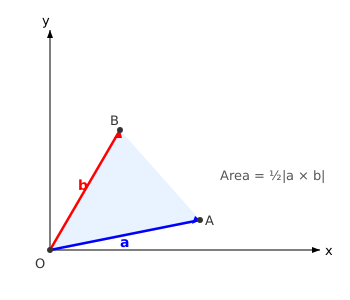
Theorem (Area of a Triangle): If a \mathbf{a} a b \mathbf{b} b
Area of triangle OAB = 1 2 ∣ a × b ∣ \text{Area of triangle OAB} = \frac{1}{2}|\mathbf{a} \times \mathbf{b}| Area of triangle OAB = 2 1 ∣ a × b ∣ Proof. The area of triangle OAB is 1 2 ∣ a ∣ ∣ b ∣ sin θ \frac{1}{2}|\mathbf{a}||\mathbf{b}|\sin\theta 2 1 ∣ a ∣∣ b ∣ sin θ θ \theta θ a \mathbf{a} a b \mathbf{b} b 1 2 ∣ a × b ∣ \frac{1}{2}|\mathbf{a} \times \mathbf{b}| 2 1 ∣ a × b ∣ □ \square □
Area of triangle OAB = 1 2 ∣ a × b ∣ \frac{1}{2}|\mathbf{a} \times \mathbf{b}| 2 1 ∣ a × b ∣
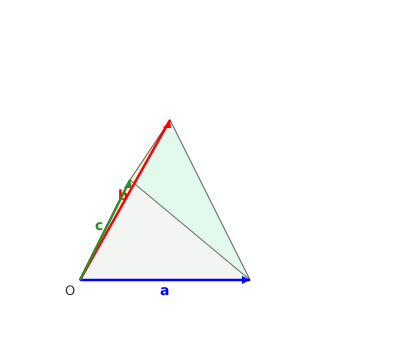
Area of triangle ABC = 1 2 ∣ ( b − a ) × ( c − a ) ∣ \frac{1}{2}|(\mathbf{b} - \mathbf{a}) \times (\mathbf{c} - \mathbf{a})| 2 1 ∣ ( b − a ) × ( c − a ) ∣
Area of parallelogram OABC = ∣ a × b ∣ |\mathbf{a} \times \mathbf{b}| ∣ a × b ∣
Area of parallelogram ABCD = ∣ ( b − a ) × ( d − a ) ∣ |(\mathbf{b} - \mathbf{a}) \times (\mathbf{d} - \mathbf{a})| ∣ ( b − a ) × ( d − a ) ∣
Example (Area of a Triangle): Find the area of triangle ABC, where the position vectors of A, B and C are 4 i − 2 j + k 4\mathbf{i} - 2\mathbf{j} + \mathbf{k} 4 i − 2 j + k − 12 i + 14 j + k -12\mathbf{i} + 14\mathbf{j} + \mathbf{k} − 12 i + 14 j + k − 4 i − 2 j + k -4\mathbf{i} - 2\mathbf{j} + \mathbf{k} − 4 i − 2 j + k
Definition (Scalar Triple Product): The scalar triple product of three vectors a \mathbf{a} a b \mathbf{b} b c \mathbf{c} c
a ⋅ ( b × c ) \mathbf{a} \cdot (\mathbf{b} \times \mathbf{c}) a ⋅ ( b × c ) Example (Computing Scalar Triple Product): Calculate the scalar triple product a ⋅ ( b × c ) \mathbf{a} \cdot (\mathbf{b} \times \mathbf{c}) a ⋅ ( b × c )
a = 2 i − j + 3 k , b = i + 2 j − k , c = 3 i − j + 2 k \mathbf{a} = 2\mathbf{i} - \mathbf{j} + 3\mathbf{k}, \quad \mathbf{b} = \mathbf{i} + 2\mathbf{j} - \mathbf{k}, \quad \mathbf{c} = 3\mathbf{i} - \mathbf{j} + 2\mathbf{k} a = 2 i − j + 3 k , b = i + 2 j − k , c = 3 i − j + 2 k Solution:
Method 1: First compute the cross product b × c \mathbf{b} \times \mathbf{c} b × c a \mathbf{a} a
b × c = ∣ i j k 1 2 − 1 3 − 1 2 ∣ = i ∣ 2 − 1 − 1 2 ∣ − j ∣ 1 − 1 3 2 ∣ + k ∣ 1 2 3 − 1 ∣ = i ( 4 − 1 ) − j ( 2 + 3 ) + k ( − 1 − 6 ) = 3 i − 5 j − 7 k \begin{aligned}
\mathbf{b} \times \mathbf{c} &= \begin{vmatrix}
\mathbf{i} & \mathbf{j} & \mathbf{k} \\
1 & 2 & -1 \\
3 & -1 & 2
\end{vmatrix}\\
&= \mathbf{i}\begin{vmatrix} 2 & -1 \\ -1 & 2 \end{vmatrix} - \mathbf{j}\begin{vmatrix} 1 & -1 \\ 3 & 2 \end{vmatrix} + \mathbf{k}\begin{vmatrix} 1 & 2 \\ 3 & -1 \end{vmatrix}\\
&= \mathbf{i}(4 - 1) - \mathbf{j}(2 + 3) + \mathbf{k}(-1 - 6)\\
&= 3\mathbf{i} - 5\mathbf{j} - 7\mathbf{k}
\end{aligned} b × c = i 1 3 j 2 − 1 k − 1 2 = i 2 − 1 − 1 2 − j 1 3 − 1 2 + k 1 3 2 − 1 = i ( 4 − 1 ) − j ( 2 + 3 ) + k ( − 1 − 6 ) = 3 i − 5 j − 7 k Now we compute the dot product:
a ⋅ ( b × c ) = ( 2 i − j + 3 k ) ⋅ ( 3 i − 5 j − 7 k ) = 6 + 5 − 21 = − 10 \begin{aligned}
\mathbf{a} \cdot (\mathbf{b} \times \mathbf{c}) &= (2\mathbf{i} - \mathbf{j} + 3\mathbf{k}) \cdot (3\mathbf{i} - 5\mathbf{j} - 7\mathbf{k})\\
&= 6 + 5 - 21 = -10
\end{aligned} a ⋅ ( b × c ) = ( 2 i − j + 3 k ) ⋅ ( 3 i − 5 j − 7 k ) = 6 + 5 − 21 = − 10 Method 2: Use the determinant formula directly.
a ⋅ ( b × c ) = ∣ 2 − 1 3 1 2 − 1 3 − 1 2 ∣ = 2 ( 4 − 1 ) + 1 ( 2 + 3 ) + 3 ( − 1 − 6 ) = 6 + 5 − 21 = − 10 \begin{aligned}
\mathbf{a} \cdot (\mathbf{b} \times \mathbf{c}) &= \begin{vmatrix}
2 & -1 & 3 \\
1 & 2 & -1 \\
3 & -1 & 2
\end{vmatrix}\\
&= 2(4 - 1) + 1(2 + 3) + 3(-1 - 6)\\
&= 6 + 5 - 21 = -10
\end{aligned} a ⋅ ( b × c ) = 2 1 3 − 1 2 − 1 3 − 1 2 = 2 ( 4 − 1 ) + 1 ( 2 + 3 ) + 3 ( − 1 − 6 ) = 6 + 5 − 21 = − 10 Theorem (Volume of a Parallelepiped): The volume of a parallelepiped with edges a \mathbf{a} a b \mathbf{b} b c \mathbf{c} c
Volume = ∣ a ⋅ ( b × c ) ∣ \text{Volume} = |\mathbf{a} \cdot (\mathbf{b} \times \mathbf{c})| Volume = ∣ a ⋅ ( b × c ) ∣
Theorem (Volume of a Tetrahedron): The volume of a tetrahedron with vertices at the origin and at points with position vectors a \mathbf{a} a b \mathbf{b} b c \mathbf{c} c
Volume = 1 6 ∣ a ⋅ ( b × c ) ∣ \text{Volume} = \frac{1}{6}|\mathbf{a} \cdot (\mathbf{b} \times \mathbf{c})| Volume = 6 1 ∣ a ⋅ ( b × c ) ∣
Example (Volume of a Tetrahedron): Find the volume of the tetrahedron with vertices at A(1, 3, 0), B(3, 2, -1), C(2, -1, -1) and D(-1, 3, 6).
Solution:
A B → = ( 2 , − 1 , − 1 ) A C → = ( 1 , − 4 , − 1 ) A D → = ( − 2 , 0 , 6 ) \begin{aligned}
\overrightarrow{AB} &= (2, -1, -1) \\
\overrightarrow{AC} &= (1, -4, -1) \\
\overrightarrow{AD} &= (-2, 0, 6)
\end{aligned} A B A C A D = ( 2 , − 1 , − 1 ) = ( 1 , − 4 , − 1 ) = ( − 2 , 0 , 6 ) The volume is given by:
V = 1 6 ∣ A B → ⋅ ( A C → × A D → ) ∣ = 1 6 ∣ ∣ 2 − 1 − 1 1 − 4 − 1 − 2 0 6 ∣ ∣ = 1 6 ∣ 36 ∣ = 6 \begin{aligned}
V &= \frac{1}{6}|\overrightarrow{AB} \cdot (\overrightarrow{AC} \times \overrightarrow{AD})| \\
&= \frac{1}{6}\left|\begin{vmatrix}
2 & -1 & -1 \\
1 & -4 & -1 \\
-2 & 0 & 6
\end{vmatrix}\right| \\
&= \frac{1}{6}|36| = 6
\end{aligned} V = 6 1 ∣ A B ⋅ ( A C × A D ) ∣ = 6 1 2 1 − 2 − 1 − 4 0 − 1 − 1 6 = 6 1 ∣36∣ = 6
Find the volume of the tetrahedron with vertices at O(0, 0, 0), A(2, 2, 1), B(3, -1, 2), and C(1, 1, 3).
A line in three-dimensional space can be represented in several equivalent forms. We’ll start with the parametric form and then explore the vector equation.
Definition (Parametric Form of a Line): If a line passes through a point with coordinates ( x 1 , y 1 , z 1 ) (x_1, y_1, z_1) ( x 1 , y 1 , z 1 ) b = ( l , m , n ) \mathbf{b} = (l, m, n) b = ( l , m , n ) ( x , y , z ) (x, y, z) ( x , y , z )
x = x 1 + λ l y = y 1 + λ m z = z 1 + λ n \begin{aligned}
x &= x_1 + \lambda l\\
y &= y_1 + \lambda m\\
z &= z_1 + \lambda n
\end{aligned} x y z = x 1 + λ l = y 1 + λm = z 1 + λn where λ \lambda λ
This can be equivalently written in the form:
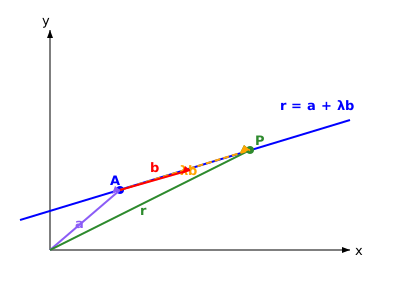
x − x 1 l = y − y 1 m = z − z 1 n = λ \frac{x-x_1}{l} = \frac{y-y_1}{m} = \frac{z-z_1}{n} = \lambda l x − x 1 = m y − y 1 = n z − z 1 = λ Definition (Vector Equation of a Line): For a line passing through point A A A a \mathbf{a} a b \mathbf{b} b
r = a + λ b \mathbf{r} = \mathbf{a} + \lambda\mathbf{b} r = a + λ b where r \mathbf{r} r λ \lambda λ
Note that this can also be expressed using the cross product:
( r − a ) × b = 0 (\mathbf{r} - \mathbf{a}) \times \mathbf{b} = \mathbf{0} ( r − a ) × b = 0
Example (Finding the Equation of a Line): Find the vector equation of the line through the points (1, 2, -1) and (3, -2, 2) in the form ( r − a ) × b = 0 (\mathbf{r} - \mathbf{a}) \times \mathbf{b} = \mathbf{0} ( r − a ) × b = 0
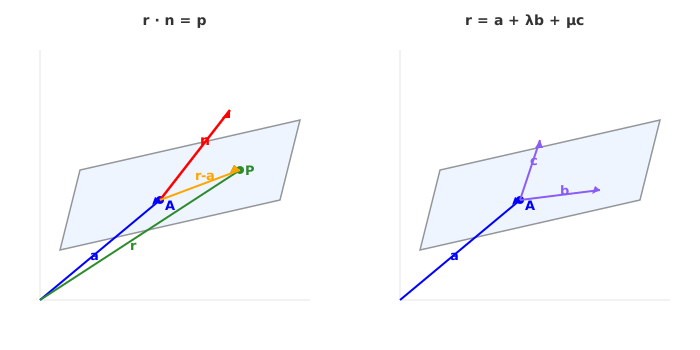
Definition (Vector Equation of a Plane): A plane can be represented in several forms:
Scalar product form: r ⋅ n = p \mathbf{r} \cdot \mathbf{n} = p r ⋅ n = p n \mathbf{n} n p p p Point-normal form: ( r − a ) ⋅ n = 0 (\mathbf{r} - \mathbf{a}) \cdot \mathbf{n} = 0 ( r − a ) ⋅ n = 0 a \mathbf{a} a Parametric form: r = a + λ b + μ c \mathbf{r} = \mathbf{a} + \lambda\mathbf{b} + \mu\mathbf{c} r = a + λ b + μ c b \mathbf{b} b c \mathbf{c} c λ \lambda λ μ \mu μ Cartesian form: a x + b y + c z + d = 0 ax + by + cz + d = 0 a x + b y + cz + d = 0
Example (Converting Between Plane Representations): Find different forms of the equation of a plane passing through the point P ( 2 , 1 , 3 ) P(2,1,3) P ( 2 , 1 , 3 ) n = ( 3 , 2 , − 1 ) \mathbf{n} = (3,2,-1) n = ( 3 , 2 , − 1 )
Solution:
(a) Point-normal form:
The point-normal form is:
( r − a ) ⋅ n = 0 (\mathbf{r} - \mathbf{a}) \cdot \mathbf{n} = 0 ( r − a ) ⋅ n = 0 where a = 2 i + j + 3 k \mathbf{a} = 2\mathbf{i} + \mathbf{j} + 3\mathbf{k} a = 2 i + j + 3 k n = 3 i + 2 j − k \mathbf{n} = 3\mathbf{i} + 2\mathbf{j} - \mathbf{k} n = 3 i + 2 j − k
(b) Scalar product form:
Expanding the point-normal form:
( r − a ) ⋅ n = 0 r ⋅ n = a ⋅ n \begin{aligned}
(\mathbf{r} - \mathbf{a}) \cdot \mathbf{n} &= 0\\
\mathbf{r} \cdot \mathbf{n} &= \mathbf{a} \cdot \mathbf{n}
\end{aligned} ( r − a ) ⋅ n r ⋅ n = 0 = a ⋅ n Computing the constant term:
a ⋅ n = ( 2 i + j + 3 k ) ⋅ ( 3 i + 2 j − k ) = 6 + 2 − 3 = 5 \mathbf{a} \cdot \mathbf{n} = (2\mathbf{i} + \mathbf{j} + 3\mathbf{k}) \cdot (3\mathbf{i} + 2\mathbf{j} - \mathbf{k}) = 6 + 2 - 3 = 5 a ⋅ n = ( 2 i + j + 3 k ) ⋅ ( 3 i + 2 j − k ) = 6 + 2 − 3 = 5 Therefore, the scalar product form is r ⋅ n = 5 \mathbf{r} \cdot \mathbf{n} = 5 r ⋅ n = 5 n = 3 i + 2 j − k \mathbf{n} = 3\mathbf{i} + 2\mathbf{j} - \mathbf{k} n = 3 i + 2 j − k
(c) Cartesian form:
Setting r = x i + y j + z k \mathbf{r} = x\mathbf{i} + y\mathbf{j} + z\mathbf{k} r = x i + y j + z k
3 x + 2 y − z = 5 3x + 2y - z = 5 3 x + 2 y − z = 5 (d) Parametric form:
To find this form, we need to find two non-parallel vectors that lie in the plane. Since these vectors must be perpendicular to the normal vector n = ( 3 , 2 , − 1 ) \mathbf{n} = (3,2,-1) n = ( 3 , 2 , − 1 ) b = ( − 2 , 3 , 0 ) \mathbf{b} = (-2,3,0) b = ( − 2 , 3 , 0 ) c = ( 1 , 0 , 3 ) \mathbf{c} = (1,0,3) c = ( 1 , 0 , 3 )
Verification:
n ⋅ b = 3 ( − 2 ) + 2 ( 3 ) + ( − 1 ) ( 0 ) = 0 n ⋅ c = 3 ( 1 ) + 2 ( 0 ) + ( − 1 ) ( 3 ) = 0 \begin{aligned}
\mathbf{n} \cdot \mathbf{b} &= 3(-2) + 2(3) + (-1)(0) = 0\\
\mathbf{n} \cdot \mathbf{c} &= 3(1) + 2(0) + (-1)(3) = 0
\end{aligned} n ⋅ b n ⋅ c = 3 ( − 2 ) + 2 ( 3 ) + ( − 1 ) ( 0 ) = 0 = 3 ( 1 ) + 2 ( 0 ) + ( − 1 ) ( 3 ) = 0 The parametric form is:
r = ( 2 i + j + 3 k ) + λ ( − 2 i + 3 j ) + μ ( i + 3 k ) \mathbf{r} = (2\mathbf{i} + \mathbf{j} + 3\mathbf{k}) + \lambda(-2\mathbf{i} + 3\mathbf{j}) + \mu(\mathbf{i} + 3\mathbf{k}) r = ( 2 i + j + 3 k ) + λ ( − 2 i + 3 j ) + μ ( i + 3 k )
Example (Line-Plane Intersection): Find the point of intersection between the line r = ( 2 , 1 , 3 ) + t ( 1 , 2 , − 1 ) \mathbf{r} = (2, 1, 3) + t(1, 2, -1) r = ( 2 , 1 , 3 ) + t ( 1 , 2 , − 1 ) 2 x − y + 3 z = 8 2x - y + 3z = 8 2 x − y + 3 z = 8
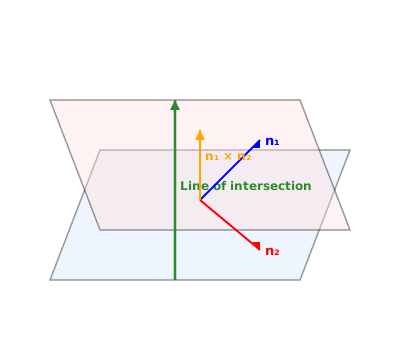
Example (Plane-Plane Intersection): Find the line of intersection between the planes 2 x + y − z = 3 2x + y - z = 3 2 x + y − z = 3 x − y + 2 z = 4 x - y + 2z = 4 x − y + 2 z = 4
Find the point of intersection between the line r = ( 1 , 0 , 2 ) + t ( 2 , 1 , 3 ) \mathbf{r} = (1, 0, 2) + t(2, 1, 3) r = ( 1 , 0 , 2 ) + t ( 2 , 1 , 3 ) 3 x − 2 y + z = 5 3x - 2y + z = 5 3 x − 2 y + z = 5
Determine whether the lines r = ( 1 , 2 , 3 ) + s ( 2 , 3 , 1 ) \mathbf{r} = (1, 2, 3) + s(2, 3, 1) r = ( 1 , 2 , 3 ) + s ( 2 , 3 , 1 ) r = ( 2 , 1 , 4 ) + t ( 4 , 6 , 2 ) \mathbf{r} = (2, 1, 4) + t(4, 6, 2) r = ( 2 , 1 , 4 ) + t ( 4 , 6 , 2 )
Find the line of intersection between the planes x + 2 y + z = 4 x + 2y + z = 4 x + 2 y + z = 4 2 x − y + 3 z = 5 2x - y + 3z = 5 2 x − y + 3 z = 5
1. Angle Between Two Vectors:
cos θ = a ⋅ b ∣ a ∣ ∣ b ∣ \cos\theta = \frac{\mathbf{a}\cdot\mathbf{b}}{|\mathbf{a}||\mathbf{b}|} cos θ = ∣ a ∣∣ b ∣ a ⋅ b
2. Angle Between Line and Plane:
sin θ = ∣ b ⋅ n ∣ ∣ b ∣ ∣ n ∣ \sin\theta = \frac{|\mathbf{b} \cdot \mathbf{n}|}{|\mathbf{b}||\mathbf{n}|} sin θ = ∣ b ∣∣ n ∣ ∣ b ⋅ n ∣ where b \mathbf{b} b n \mathbf{n} n
3. Angle Between Two Planes:
cos θ = ∣ n 1 ⋅ n 2 ∣ ∣ n 1 ∣ ∣ n 2 ∣ \cos\theta = \frac{|\mathbf{n}_1 \cdot \mathbf{n}_2|}{|\mathbf{n}_1||\mathbf{n}_2|} cos θ = ∣ n 1 ∣∣ n 2 ∣ ∣ n 1 ⋅ n 2 ∣ where n 1 \mathbf{n}_1 n 1 n 2 \mathbf{n}_2 n 2
1. Angle Between Line and Plane:
For a line with direction vector b \mathbf{b} b n \mathbf{n} n θ \theta θ
sin θ = ∣ b ⋅ n ∣ ∣ b ∣ ∣ n ∣ \sin\theta = \frac{|\mathbf{b} \cdot \mathbf{n}|}{|\mathbf{b}||\mathbf{n}|} sin θ = ∣ b ∣∣ n ∣ ∣ b ⋅ n ∣
The angle α \alpha α b \mathbf{b} b n \mathbf{n} n cos α = ∣ b ⋅ n ∣ ∣ b ∣ ∣ n ∣ \cos\alpha = \frac{|\mathbf{b} \cdot \mathbf{n}|}{|\mathbf{b}||\mathbf{n}|} cos α = ∣ b ∣∣ n ∣ ∣ b ⋅ n ∣
From the diagram, we can see that θ \theta θ α \alpha α θ = π 2 − α \theta = \frac{\pi}{2} - \alpha θ = 2 π − α sin θ = cos α \sin\theta = \cos\alpha sin θ = cos α
2. Angle Between Two Planes:
For planes with normal vectors n 1 \mathbf{n}_1 n 1 n 2 \mathbf{n}_2 n 2
cos θ = ∣ n 1 ⋅ n 2 ∣ ∣ n 1 ∣ ∣ n 2 ∣ \cos\theta = \frac{|\mathbf{n}_1 \cdot \mathbf{n}_2|}{|\mathbf{n}_1||\mathbf{n}_2|} cos θ = ∣ n 1 ∣∣ n 2 ∣ ∣ n 1 ⋅ n 2 ∣
The acute angle θ \theta θ n 1 \mathbf{n}_1 n 1 n 2 \mathbf{n}_2 n 2 cos θ = ∣ n 1 ⋅ n 2 ∣ ∣ n 1 ∣ ∣ n 2 ∣ \cos\theta = \frac{|\mathbf{n}_1 \cdot \mathbf{n}_2|}{|\mathbf{n}_1||\mathbf{n}_2|} cos θ = ∣ n 1 ∣∣ n 2 ∣ ∣ n 1 ⋅ n 2 ∣
From the diagram, we can see that θ \theta θ
Example (Angle Between Line and Plane): Find the acute angle between the line r = 2 i + j − 5 k + λ ( 3 i + 4 j − 12 k ) \mathbf{r} = 2\mathbf{i} + \mathbf{j} - 5\mathbf{k} + \lambda(3\mathbf{i} + 4\mathbf{j} - 12\mathbf{k}) r = 2 i + j − 5 k + λ ( 3 i + 4 j − 12 k ) r ⋅ ( 2 i − 2 j − k ) = 2 \mathbf{r}\cdot(2\mathbf{i} - 2\mathbf{j} - \mathbf{k}) = 2 r ⋅ ( 2 i − 2 j − k ) = 2
1. Distance from Point to Plane:
Distance = ∣ ( p − r ) ⋅ n ∣ ∣ n ∣ = ∣ p ⋅ n − a ∣ ∣ n ∣ \text{Distance} = \frac{|(\mathbf{p}-\mathbf{r}) \cdot \mathbf{n}|}{|\mathbf{n}|} = \frac{|\mathbf{p} \cdot \mathbf{n} - a|}{|\mathbf{n}|} Distance = ∣ n ∣ ∣ ( p − r ) ⋅ n ∣ = ∣ n ∣ ∣ p ⋅ n − a ∣ where plane equation is r ⋅ n = a \mathbf{r}\cdot\mathbf{n} = a r ⋅ n = a
2. Distance from Point to Line:
Distance = ∣ p − a ∣ sin θ = ∣ ( p − a ) × b ∣ ∣ b ∣ \text{Distance} = |\mathbf{p} - \mathbf{a}| \sin\theta = \frac{|(\mathbf{p} - \mathbf{a}) \times \mathbf{b}|}{|\mathbf{b}|} Distance = ∣ p − a ∣ sin θ = ∣ b ∣ ∣ ( p − a ) × b ∣ where line equation is r = a + λ b \mathbf{r} = \mathbf{a} + \lambda\mathbf{b} r = a + λ b
3. Distance Between Skew Lines:
Distance = ∣ ( a − c ) ⋅ ( b × d ) ∣ ∣ b × d ∣ \text{Distance} = \frac{|(\mathbf{a} - \mathbf{c}) \cdot (\mathbf{b} \times \mathbf{d})|}{|\mathbf{b} \times \mathbf{d}|} Distance = ∣ b × d ∣ ∣ ( a − c ) ⋅ ( b × d ) ∣ where line equations are r = a + λ b \mathbf{r} = \mathbf{a} + \lambda\mathbf{b} r = a + λ b r = c + μ d \mathbf{r} = \mathbf{c} + \mu\mathbf{d} r = c + μ d
1. Point to Plane:
The shortest distance from a point to a plane is along the perpendicular to the plane. The formula ∣ ( p − r ) ⋅ n ∣ ∣ n ∣ \frac{|(\mathbf{p}-\mathbf{r}) \cdot \mathbf{n}|}{|\mathbf{n}|} ∣ n ∣ ∣ ( p − r ) ⋅ n ∣
Picking a point on the plane r \mathbf{r} r
Projecting the position vector p − r \mathbf{p}-\mathbf{r} p − r n \mathbf{n} n
Computing the magnitude of the projection
2. Point to Line:
The formula ∣ ( p − a ) × b ∣ ∣ b ∣ \frac{|(\mathbf{p} - \mathbf{a}) \times \mathbf{b}|}{|\mathbf{b}|} ∣ b ∣ ∣ ( p − a ) × b ∣
Picking a point on the line a \mathbf{a} a
Computing the magnitude of the cross product of p − a \mathbf{p} - \mathbf{a} p − a b \mathbf{b} b
This can be visualized as the quantity ∣ p − a ∣ ∣ b ∣ sin θ |\mathbf{p} - \mathbf{a}||\mathbf{b}|\sin\theta ∣ p − a ∣∣ b ∣ sin θ θ \theta θ p − a \mathbf{p} - \mathbf{a} p − a b \mathbf{b} b
Dividing by ∣ b ∣ |\mathbf{b}| ∣ b ∣
3. Skew Lines:
For skew lines (lines in 3D space that neither intersect nor are parallel), the formula ∣ ( a − c ) ⋅ ( b × d ) ∣ ∣ b × d ∣ \frac{|(\mathbf{a} - \mathbf{c}) \cdot (\mathbf{b} \times \mathbf{d})|}{|\mathbf{b} \times \mathbf{d}|} ∣ b × d ∣ ∣ ( a − c ) ⋅ ( b × d ) ∣
Picking a point on each line a \mathbf{a} a c \mathbf{c} c
Computing the cross product of the direction vectors b \mathbf{b} b d \mathbf{d} d
b × d \mathbf{b} \times \mathbf{d} b × d Projecting the displacement vector a − c \mathbf{a} - \mathbf{c} a − c b × d \mathbf{b} \times \mathbf{d} b × d
Computing the magnitude of the projection
Example (Distance Between Skew Lines): Find the shortest distance between the two skew lines with equations r = i + λ ( j + k ) \mathbf{r} = \mathbf{i} + \lambda(\mathbf{j} + \mathbf{k}) r = i + λ ( j + k ) r = − i + 3 j − k + μ ( 2 i − j − k ) \mathbf{r} = -\mathbf{i} + 3\mathbf{j} - \mathbf{k} + \mu(2\mathbf{i} - \mathbf{j} - \mathbf{k}) r = − i + 3 j − k + μ ( 2 i − j − k ) λ \lambda λ μ \mu μ
Example (Distance from Point to Plane): Find the distance from the point P ( 3 , 1 , − 2 ) P(3, 1, -2) P ( 3 , 1 , − 2 ) 2 x − y + 2 z = 5 2x - y + 2z = 5 2 x − y + 2 z = 5
Forgetting that the vector product is not commutative: a × b ≠ b × a \mathbf{a} \times \mathbf{b} \neq \mathbf{b} \times \mathbf{a} a × b = b × a
Calculating a × a \mathbf{a} \times \mathbf{a} a × a
Using the wrong formula for the angle between a line and a plane (it’s sin θ \sin\theta sin θ cos θ \cos\theta cos θ
Not normalizing the normal vector when finding the perpendicular distance from the origin to a plane
Forgetting to take the absolute value in distance formulas
Confusing the parametric representation of a line (r = a + λ b \mathbf{r} = \mathbf{a} + \lambda\mathbf{b} r = a + λ b ( r − a ) × b = 0 (\mathbf{r} - \mathbf{a}) \times \mathbf{b} = \mathbf{0} ( r − a ) × b = 0
The points A A A B B B C C C a \mathbf{a} a b \mathbf{b} b c \mathbf{c} c O O O
It is given that:
a = i + j \mathbf{a} = \mathbf{i} + \mathbf{j} a = i + j b = 3 i − j + k \quad \mathbf{b} = 3\mathbf{i} - \mathbf{j} + \mathbf{k} b = 3 i − j + k c = 2 i + j − k \quad \mathbf{c} = 2\mathbf{i} + \mathbf{j} - \mathbf{k} c = 2 i + j − k
Calculate:
(a) b × c \mathbf{b} \times \mathbf{c} b × c (3 marks)
(b) a ⋅ ( b × c ) \mathbf{a} \cdot (\mathbf{b} \times \mathbf{c}) a ⋅ ( b × c ) (2 marks)
(c) the area of triangle O B C OBC O B C (2 marks)
(d) the volume of the tetrahedron O A B C OABC O A B C (1 mark)
The position vectors of the points A A A B B B C C C O O O i − 2 j − 2 k \mathbf{i} - 2\mathbf{j} - 2\mathbf{k} i − 2 j − 2 k 7 i − 3 k 7\mathbf{i} - 3\mathbf{k} 7 i − 3 k 4 i + 4 j 4\mathbf{i} + 4\mathbf{j} 4 i + 4 j
Find:
(a) A C → × B C → \overrightarrow{AC} \times \overrightarrow{BC} A C × B C (4 marks)
(b) the area of triangle A B C ABC A B C (2 marks)
(c) an equation of the plane A B C ABC A B C r ⋅ n = p \mathbf{r} \cdot \mathbf{n} = p r ⋅ n = p (2 marks)
The plane P P P
r = ( 3 1 2 ) + λ ( 0 2 − 1 ) + μ ( 3 2 2 ) \mathbf{r} = \begin{pmatrix} 3 \\ 1 \\ 2 \end{pmatrix} + \lambda \begin{pmatrix} 0 \\ 2 \\ -1 \end{pmatrix} + \mu \begin{pmatrix} 3 \\ 2 \\ 2 \end{pmatrix} r = 3 1 2 + λ 0 2 − 1 + μ 3 2 2 (a) Find a vector perpendicular to the plane P P P (2 marks)
The line l l l A ( 1 , 3 , 3 ) A(1, 3, 3) A ( 1 , 3 , 3 ) P P P ( 3 , 1 , 2 ) (3, 1, 2) ( 3 , 1 , 2 )
The acute angle between the plane P P P l l l α \alpha α
(b) Find α \alpha α (4 marks)
(c) Find the perpendicular distance from A A A P P P (4 marks)
The lines l 1 l_1 l 1 l 2 l_2 l 2
r = ( 1 − 1 2 ) + λ ( − 1 3 4 ) and r = ( a − 4 0 ) + μ ( 0 3 2 ) \mathbf{r} = \begin{pmatrix} 1 \\ -1 \\ 2 \end{pmatrix} + \lambda \begin{pmatrix} -1 \\ 3 \\ 4 \end{pmatrix} \quad \text{and} \quad \mathbf{r} = \begin{pmatrix} a \\ -4 \\ 0 \end{pmatrix} + \mu \begin{pmatrix} 0 \\ 3 \\ 2 \end{pmatrix} r = 1 − 1 2 + λ − 1 3 4 and r = a − 4 0 + μ 0 3 2 If the lines l 1 l_1 l 1 l 2 l_2 l 2 a a a (4 marks)
(b) an equation for the plane containing the lines l 1 l_1 l 1 l 2 l_2 l 2 a x + b y + c z + d = 0 ax + by + cz + d = 0 a x + b y + cz + d = 0 a a a b b b c c c d d d (4 marks)
For other values of a a a l 1 l_1 l 1 l 2 l_2 l 2
Given that a = 2 a = 2 a = 2
(c) find the shortest distance between the lines l 1 l_1 l 1 l 2 l_2 l 2 (3 marks)
The plane Π \Pi Π
r = 3 i + k + λ ( − 4 i + j ) + μ ( 6 i − 2 j + k ) \mathbf{r} = 3\mathbf{i} + \mathbf{k} + \lambda(-4\mathbf{i} + \mathbf{j}) + \mu(6\mathbf{i} - 2\mathbf{j} + \mathbf{k}) r = 3 i + k + λ ( − 4 i + j ) + μ ( 6 i − 2 j + k ) (a) Find an equation of Π \Pi Π r ⋅ n = p \mathbf{r}\cdot\mathbf{n} = p r ⋅ n = p n \mathbf{n} n Π \Pi Π p p p (5 marks)
The point P P P ( 6 , 13 , 5 ) (6, 13, 5) ( 6 , 13 , 5 ) l l l P P P Π \Pi Π l l l Π \Pi Π N N N
(b) Show that the coordinates of N N N ( 3 , 1 , − 1 ) (3, 1, -1) ( 3 , 1 , − 1 ) (4 marks)
The point R R R Π \Pi Π ( 1 , 0 , 2 ) (1, 0, 2) ( 1 , 0 , 2 )
(c) Find the perpendicular distance from N N N P R PR P R (5 marks)