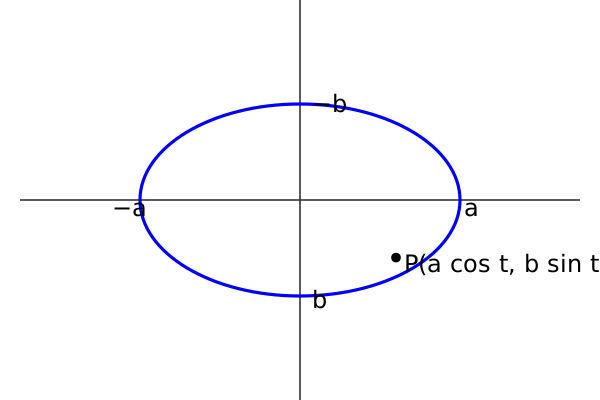
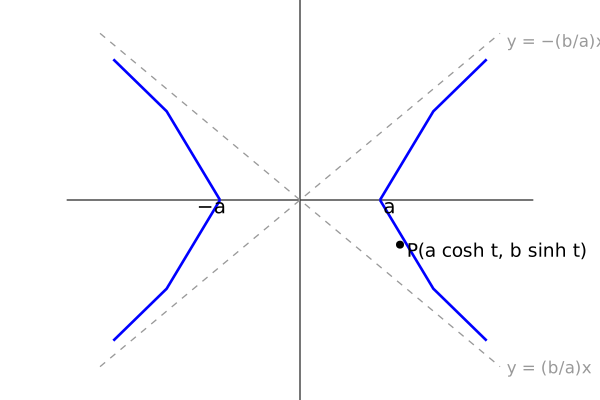
Having explored parabolas and rectangular hyperbolas in the previous modules, we now turn our attention to their cousins: ellipses and general hyperbolas. These curves appear frequently in nature and have fascinating applications, from planetary orbits to satellite dishes. We’ll discover how these curves are unified through the concept of eccentricity and explore their geometric properties.
This chapter covers the identification of ellipses and hyperbolas from their equations, finding foci, directrices, and eccentricity, and solving loci problems. It also includes finding tangents and normals to these curves.
Based on past papers and examiner reports, these areas require particular attention:
1. Calculus Applications
Parametric differentiation vs. implicit differentiation
Finding equations of tangents and normals
Area calculations involving points on conics
2. Geometric Understanding
Relationship between parameters and shape
Interpretation of negative coordinates
Understanding of loci problems
3. Technical Proficiency
Correct use of standard forms
Manipulation of trigonometric identities
Clear presentation of working
Let’s derive the equation of the tangent to the ellipse x 2 a 2 + y 2 b 2 = 1 \dfrac{x^2}{a^2} + \dfrac{y^2}{b^2} = 1 a 2 x 2 + b 2 y 2 = 1 P ( x 1 , y 1 ) P(x_1, y_1) P ( x 1 , y 1 )
Finding Tangent using Implicit Differentiation
Differentiate both sides with respect to x x x
2 x a 2 + 2 y b 2 d y d x = 0 \frac{2x}{a^2} + \frac{2y}{b^2}\frac{dy}{dx} = 0 a 2 2 x + b 2 2 y d x d y = 0
Solve for d y d x \dfrac{dy}{dx} d x d y
d y d x = − b 2 x a 2 y \frac{dy}{dx} = -\frac{b^2x}{a^2y} d x d y = − a 2 y b 2 x
At point P ( x 1 , y 1 ) P(x_1, y_1) P ( x 1 , y 1 )
m = − b 2 x 1 a 2 y 1 m = -\frac{b^2x_1}{a^2y_1} m = − a 2 y 1 b 2 x 1
Use point-gradient form y − y 1 = m ( x − x 1 ) y - y_1 = m(x - x_1) y − y 1 = m ( x − x 1 )
y − y 1 = − b 2 x 1 a 2 y 1 ( x − x 1 ) y - y_1 = -\frac{b^2x_1}{a^2y_1}(x - x_1) y − y 1 = − a 2 y 1 b 2 x 1 ( x − x 1 )
Multiply throughout by a 2 y 1 a^2y_1 a 2 y 1
a 2 y 1 y − a 2 y 1 2 = − b 2 x 1 x + b 2 x 1 2 a^2y_1y - a^2y_1^2 = -b^2x_1x + b^2x_1^2 a 2 y 1 y − a 2 y 1 2 = − b 2 x 1 x + b 2 x 1 2
Since ( x 1 , y 1 ) (x_1, y_1) ( x 1 , y 1 ) x 1 2 a 2 + y 1 2 b 2 = 1 \dfrac{x_1^2}{a^2} + \dfrac{y_1^2}{b^2} = 1 a 2 x 1 2 + b 2 y 1 2 = 1
After simplification:
x x 1 a 2 + y y 1 b 2 = 1 \frac{xx_1}{a^2} + \frac{yy_1}{b^2} = 1 a 2 x x 1 + b 2 y y 1 = 1
Finding Tangent using Parametric Differentiation
Use parametric equations: x = a cos t x = a\cos t x = a cos t y = b sin t y = b\sin t y = b sin t
Find d y d x \dfrac{dy}{dx} d x d y
d y d x = d y d t d x d t = b cos t − a sin t = − b cos t a sin t \frac{dy}{dx} = \frac{\frac{dy}{dt}}{\frac{dx}{dt}} = \frac{b\cos t}{-a\sin t} = -\frac{b\cos t}{a\sin t} d x d y = d t d x d t d y = − a s i n t b c o s t = − a s i n t b c o s t
Use point-gradient form:
y − b sin t = − b cos t a sin t ( x − a cos t ) y - b\sin t = -\frac{b\cos t}{a\sin t}(x - a\cos t) y − b sin t = − a s i n t b c o s t ( x − a cos t )
Simplify to:
b x cos t + a y sin t = a b bx\cos t + ay\sin t = ab b x cos t + a y sin t = ab
Finding Normal using Parametric Form
At point P ( a cos t , b sin t ) P(a\cos t, b\sin t) P ( a cos t , b sin t )
Normal gradient: a sin t b cos t \dfrac{a\sin t}{b\cos t} b cos t a sin t
Form equation:
y − b sin t = a sin t b cos t ( x − a cos t ) y - b\sin t = \frac{a\sin t}{b\cos t}(x - a\cos t) y − b sin t = b c o s t a s i n t ( x − a cos t )
Simplify to:
a x sin t − b y cos t = ( a 2 − b 2 ) cos t sin t ax\sin t - by\cos t = (a^2 - b^2)\cos t\sin t a x sin t − b y cos t = ( a 2 − b 2 ) cos t sin t
Find the normal to the ellipse x 2 25 + y 2 9 = 1 \dfrac{x^2}{25} + \dfrac{y^2}{9} = 1 25 x 2 + 9 y 2 = 1 P ( 5 cos θ , 3 sin θ ) P(5\cos\theta, 3\sin\theta) P ( 5 cos θ , 3 sin θ )
Step 1: Find d y d x \dfrac{dy}{dx} d x d y
d y d x = 3 cos θ − 5 sin θ = − 3 cos θ 5 sin θ \frac{dy}{dx} = \frac{3\cos\theta}{-5\sin\theta} = -\frac{3\cos\theta}{5\sin\theta} d x d y = − 5 s i n θ 3 c o s θ = − 5 s i n θ 3 c o s θ
Step 2: Use perpendicular gradient rule for normal
Normal gradient = 5 sin θ 3 cos θ \text{Normal gradient} = \frac{5\sin\theta}{3\cos\theta} Normal gradient = 3 c o s θ 5 s i n θ
Step 3: Form equation using point-gradient form
y − 3 sin θ = 5 sin θ 3 cos θ ( x − 5 cos θ ) y - 3\sin\theta = \frac{5\sin\theta}{3\cos\theta}(x - 5\cos\theta) y − 3 sin θ = 3 c o s θ 5 s i n θ ( x − 5 cos θ )
Step 4: Simplify to standard form
5 x sin θ − 3 y cos θ = 16 sin θ cos θ 5x\sin\theta - 3y\cos\theta = 16\sin\theta\cos\theta 5 x sin θ − 3 y cos θ = 16 sin θ cos θ
Don’t forget to negate the reciprocal for perpendicular gradient
Show clear substitution of point coordinates
Include intermediate steps in simplification
The elliptical dome of certain buildings exhibits an interesting acoustic property: a whisper at one focus can be clearly heard at the other focus. This is because sound waves emanating from one focus are reflected by the elliptical surface to the other focus.
This principle is used in:
St. Paul’s Cathedral, London
Grand Central Terminal, New York
The Mormon Tabernacle, Salt Lake City
Consider a hyperbola x 2 a 2 − y 2 b 2 = 1 \dfrac{x^2}{a^2} - \dfrac{y^2}{b^2} = 1 a 2 x 2 − b 2 y 2 = 1
Part 1: Using Implicit Differentiation
(a) Differentiate the equation of the hyperbola with respect to x x x
(b) Find d y d x \dfrac{dy}{dx} d x d y P ( x 1 , y 1 ) P(x_1,y_1) P ( x 1 , y 1 )
(c) Use point-gradient form to write the equation of the tangent
(d) Simplify to show that the tangent equation is x 1 x a 2 − y 1 y b 2 = 1 \dfrac{x_1x}{a^2} - \dfrac{y_1y}{b^2} = 1 a 2 x 1 x − b 2 y 1 y = 1
Part 2: Using Parametric Form
Given that a point on the hyperbola can be written as ( a cosh t , b sinh t ) (a\cosh t, b\sinh t) ( a cosh t , b sinh t ) ( a sec θ , b tan θ ) (a\sec \theta, b\tan \theta) ( a sec θ , b tan θ )
(a) Find d y d x \dfrac{dy}{dx} d x d y
(b) Write the equation of the tangent at P ( a cosh t , b sinh t ) P(a\cosh t, b\sinh t) P ( a cosh t , b sinh t ) P ( a sec θ , b tan θ ) P(a\sec \theta, b\tan \theta) P ( a sec θ , b tan θ )
(c) Show that this leads to b x cosh t − a y sinh t = a b bx\cosh t - ay\sinh t = ab b x cosh t − a y sinh t = ab b x sec θ − a y tan θ = a b bx\sec \theta - ay\tan \theta = ab b x sec θ − a y tan θ = ab
Part 3: Finding the Normal
(a) Use the perpendicular gradient rule to find the normal gradient
(b) Write the equation of the normal at P ( a cosh t , b sinh t ) P(a\cosh t, b\sinh t) P ( a cosh t , b sinh t ) P ( a sec θ , b tan θ ) P(a\sec \theta, b\tan \theta) P ( a sec θ , b tan θ )
(c) Show that this leads to a x sinh t + b y cosh t = ( a 2 + b 2 ) sinh t cosh t ax\sinh t + by\cosh t = (a^2 + b^2)\sinh t\cosh t a x sinh t + b y cosh t = ( a 2 + b 2 ) sinh t cosh t a x sin θ + b y = ( a 2 + b 2 ) tan θ ax\sin \theta + by = (a^2 + b^2)\tan \theta a x sin θ + b y = ( a 2 + b 2 ) tan θ
Hints:
Use the fact that P ( x 1 , y 1 ) P(x_1,y_1) P ( x 1 , y 1 ) x 1 2 a 2 − y 1 2 b 2 = 1 \dfrac{x_1^2}{a^2} - \dfrac{y_1^2}{b^2} = 1 a 2 x 1 2 − b 2 y 1 2 = 1
For parametric form, recall that cosh 2 t − sinh 2 t = 1 \cosh^2 t - \sinh^2 t = 1 cosh 2 t − sinh 2 t = 1 sec 2 θ − tan 2 θ = 1 \sec^2 \theta - \tan^2 \theta = 1 sec 2 θ − tan 2 θ = 1
Recall that for a parabola, any point P P P
P F = P M PF = PM P F = P M
where F F F M M M P P P
This leads to a natural generalisation: What if we consider curves where
P F P M = e \frac{PF}{PM} = e P M P F = e
where e e e e e e eccentricity .
Let’s derive the standard form of an ellipse using the eccentricity definition.
Given:
Focus F ( c , 0 ) F(c,0) F ( c , 0 )
Directrix x = a e x = \dfrac{a}{e} x = e a
Point P ( x , y ) P(x,y) P ( x , y )
P F P M = e \dfrac{PF}{PM} = e P M P F = e 0 < e < 1 0 < e < 1 0 < e < 1
Step 1: Express P F PF P F
P F = ( x − c ) 2 + y 2 PF = \sqrt{(x-c)^2 + y^2} P F = ( x − c ) 2 + y 2
Step 2: Express P M PM P M
P M = a e − x PM = \frac{a}{e} - x P M = e a − x
Step 3: Apply the definition
( x − c ) 2 + y 2 a e − x = e \frac{\sqrt{(x-c)^2 + y^2}}{\frac{a}{e} - x} = e e a − x ( x − c ) 2 + y 2 = e
Step 4: Square both sides and simplify
( x − c ) 2 + y 2 = e 2 ( a 2 e 2 − 2 a x e + x 2 ) (x-c)^2 + y^2 = e^2\!\left(\frac{a^2}{e^2} - \frac{2ax}{e} + x^2\right) ( x − c ) 2 + y 2 = e 2 ( e 2 a 2 − e 2 a x + x 2 )
Step 5: Show that this reduces to
x 2 a 2 + y 2 b 2 = 1 \frac{x^2}{a^2} + \frac{y^2}{b^2} = 1 a 2 x 2 + b 2 y 2 = 1
where b 2 = a 2 ( 1 − e 2 ) b^2 = a^2(1-e^2) b 2 = a 2 ( 1 − e 2 )
Now it’s your turn! Follow similar steps to derive the standard form of a hyperbola.
Given:
Focus F ( c , 0 ) F(c,0) F ( c , 0 )
Directrix x = a e x = \dfrac{a}{e} x = e a
Point P ( x , y ) P(x,y) P ( x , y )
P F P M = e \dfrac{PF}{PM} = e P M P F = e e > 1 e > 1 e > 1 Hints:
The key difference will be that e > 1 e > 1 e > 1
You should arrive at x 2 a 2 − y 2 b 2 = 1 \dfrac{x^2}{a^2} - \dfrac{y^2}{b^2} = 1 a 2 x 2 − b 2 y 2 = 1 b 2 = a 2 ( e 2 − 1 ) b^2 = a^2(e^2-1) b 2 = a 2 ( e 2 − 1 )
Did You Know? Halley’s Comet has an eccentricity of 0.967, making its orbit highly elliptical. This explains why it’s only visible from Earth every 76 years!
Consider a hyperbola H H H x 2 a 2 − y 2 25 = 1 \dfrac{x^2}{a^2} - \dfrac{y^2}{25} = 1 a 2 x 2 − 25 y 2 = 1 a a a e e e
Part A: Find e 2 e^2 e 2 a a a
Part B: The line l l l H H H x > 0 x > 0 x > 0 A A A A ′ A' A ′ l l l ∣ A A ′ ∣ |AA'| ∣ A A ′ ∣ e e e
Part C: Point F F F H H H x < 0 x < 0 x < 0 A F A ′ AFA' A F A ′ 164 3 \dfrac{164}{3} 3 164
30 a 3 − 164 a 2 + 375 a − 4100 = 0 30a^3 - 164a^2 + 375a - 4100 = 0 30 a 3 − 164 a 2 + 375 a − 4100 = 0
Part D: Using algebra, show that a = 20 3 a = \dfrac{20}{3} a = 3 20
Key Learning Points:
Relationship between eccentricity and the constants a a a b b b
Using asymptotes to find intersections with directrix
Area calculations involving focus and directrix
Finding the locus (path) of a point that satisfies certain conditions is a common type of problem. The key steps are:
Identify the moving point and parameters
Express coordinates in terms of parameter(s)
Eliminate parameter(s) to find the equation of the locus
Consider an ellipse E E E x 2 9 + y 2 4 = 1 \dfrac{x^2}{9} + \dfrac{y^2}{4} = 1 9 x 2 + 4 y 2 = 1 l : y = k x − 3 l: y = kx - 3 l : y = k x − 3 k k k E E E l l l
Step-by-Step Investigation:
1. Finding Intersection Points
Substitute y = k x − 3 y = kx - 3 y = k x − 3
Show that x x x ( 9 k 2 + 4 ) x 2 − 54 k x + 45 = 0 (9k^2 + 4)x^2 - 54kx + 45 = 0 ( 9 k 2 + 4 ) x 2 − 54 k x + 45 = 0
What does this tell us about the number of intersection points?
2. Locating the Midpoint
If P ( x 1 , y 1 ) P(x_1,y_1) P ( x 1 , y 1 ) Q ( x 2 , y 2 ) Q(x_2,y_2) Q ( x 2 , y 2 )
Midpoint M M M ( x 1 + x 2 2 , y 1 + y 2 2 ) \left(\dfrac{x_1+x_2}{2}, \dfrac{y_1+y_2}{2}\right) ( 2 x 1 + x 2 , 2 y 1 + y 2 )
For a quadratic a x 2 + b x + c = 0 ax^2 + bx + c = 0 a x 2 + b x + c = 0 = − b a = -\dfrac{b}{a} = − a b
3. Finding the Locus
Express x x x M M M x = 27 k 9 k 2 + 4 x = \dfrac{27k}{9k^2+4} x = 9 k 2 + 4 27 k
Express y y y M M M y = − 12 9 k 2 + 4 y = -\dfrac{12}{9k^2+4} y = − 9 k 2 + 4 12
Eliminate parameter k k k
Key Insights:
The quadratic equation helps us find intersection points without solving explicitly
The sum and product of roots give us information about the midpoint
The final locus has form x 2 + p y 2 = q y x^2 + py^2 = qy x 2 + p y 2 = q y p p p q q q
Solution: The locus is x 2 + 9 4 y 2 = − 27 4 y x^2 + \dfrac{9}{4}y^2 = -\dfrac{27}{4}y x 2 + 4 9 y 2 = − 4 27 y
Consider a parabola y 2 = 4 a x y^2 = 4ax y 2 = 4 a x P ( a p 2 , 2 a p ) P(ap^2, 2ap) P ( a p 2 , 2 a p ) Q ( a q 2 , 2 a q ) Q(aq^2, 2aq) Q ( a q 2 , 2 a q ) R R R P Q PQ P Q ( a , 0 ) (a,0) ( a , 0 )
(a) Find the coordinates of point R R R p p p q q q
(b) Prove that p q = − 1 pq = -1 pq = − 1
(c) Prove that the locus of R R R y 2 = a ( x − 3 a ) y^2 = a(x-3a) y 2 = a ( x − 3 a )
Solution:
(a) To find coordinates of R R R
Normal at P P P y + p x = 2 a p + a p 3 y + px = 2ap + ap^3 y + p x = 2 a p + a p 3
Normal at Q Q Q y + q x = 2 a q + a q 3 y + qx = 2aq + aq^3 y + q x = 2 a q + a q 3
Solving these equations simultaneously:
( p − q ) x = 2 a ( p − q ) + a ( p 3 − q 3 ) (p-q)x = 2a(p-q) + a(p^3-q^3) ( p − q ) x = 2 a ( p − q ) + a ( p 3 − q 3 )
x = 2 a + a ( p 2 + p q + q 2 ) x = 2a + a(p^2 + pq + q^2) x = 2 a + a ( p 2 + pq + q 2 )
y = − a p q ( p + q ) y = -apq(p+q) y = − a pq ( p + q )
(b) To prove p q = − 1 pq = -1 pq = − 1
Since P P P Q Q Q F ( a , 0 ) F(a,0) F ( a , 0 )
2 a p − 0 a p 2 − a = 2 a q − 0 a q 2 − a \frac{2ap-0}{ap^2-a} = \frac{2aq-0}{aq^2-a} a p 2 − a 2 a p − 0 = a q 2 − a 2 a q − 0
2 p p 2 − 1 = 2 q q 2 − 1 \frac{2p}{p^2-1} = \frac{2q}{q^2-1} p 2 − 1 2 p = q 2 − 1 2 q
p ( q 2 − 1 ) = q ( p 2 − 1 ) p(q^2-1) = q(p^2-1) p ( q 2 − 1 ) = q ( p 2 − 1 )
p q 2 − p = q p 2 − q pq^2 - p = qp^2 - q p q 2 − p = q p 2 − q
p q 2 − q p 2 = p − q pq^2 - qp^2 = p - q p q 2 − q p 2 = p − q
p q ( q − p ) = p − q pq(q-p) = p - q pq ( q − p ) = p − q
p q = − 1 pq = -1 pq = − 1
(c) To find the locus of R R R
Using p q = − 1 pq = -1 pq = − 1
x = 3 a + a ( p + q ) 2 x = 3a + a(p+q)^2 x = 3 a + a ( p + q ) 2
y = a ( p + q ) y = a(p+q) y = a ( p + q )
Let k = p + q k = p+q k = p + q
x = 3 a + a k 2 x = 3a + ak^2 x = 3 a + a k 2
y = a k y = ak y = ak
Eliminating parameter k k k
y 2 = a ( x − 3 a ) y^2 = a(x-3a) y 2 = a ( x − 3 a )
Therefore, the locus of R R R y 2 = a ( x − 3 a ) y^2 = a(x-3a) y 2 = a ( x − 3 a )
Ellipses and hyperbolas are conic sections unified by eccentricity
Standard forms help identify and analyse these curves
Practical applications include:
Planetary orbits (ellipses)
Satellite dishes (parabolas)
Cooling towers (hyperbolas)
Navigation systems (hyperbolas)
Understanding tangents and normals is crucial for applications
Confusing a a a b b b b > a b > a b > a
Forgetting to justify steps in proofs
Not showing intermediate steps when finding tangents/normals
Incorrect application of the perpendicular gradient rule
Mishandling negative coordinates in area calculations
The ellipse E E E x 2 49 + y 2 b 2 = 1 \dfrac{x^2}{49} + \dfrac{y^2}{b^2} = 1 49 x 2 + b 2 y 2 = 1 b b b 0 < b < 7 0 < b < 7 0 < b < 7 e e e
(a) Write down, in terms of e e e
The coordinates of the foci
The equations of the directrices
Given that:
the point P ( x , y ) P(x, y) P ( x , y ) E E E x > 0 x > 0 x > 0
the point S S S E E E x x x
the line l l l E E E x x x
the point M M M l l l P P P M M M x x x
(b) For point P ( x , y ) P(x,y) P ( x , y ) E E E x > 0 x > 0 x > 0
P S 2 PS^2 P S 2 e e e x x x y y y P M 2 PM^2 P M 2 e e e x x x
(c) Hence show that b 2 = 49 ( 1 − e 2 ) b^2 = 49(1-e^2) b 2 = 49 ( 1 − e 2 )
(d) Given that E E E y y y ( 0 , ± 4 3 ) (0,\pm 4\sqrt{3}) ( 0 , ± 4 3 ) e e e
(e) Given that the x x x P P P 7 2 \dfrac{7}{2} 2 7 O P M OPM O P M O O O
The hyperbola H H H x 2 a 2 − y 2 b 2 = 1 \dfrac{x^2}{a^2} - \dfrac{y^2}{b^2} = 1 a 2 x 2 − b 2 y 2 = 1
(a) Use calculus to show that the equation of the tangent to H H H ( a cosh θ , b sinh θ ) (a\cosh \theta, b\sinh \theta) ( a cosh θ , b sinh θ )
x b cosh θ − y a sinh θ = a b xb\cosh \theta - ya\sinh \theta = ab x b cosh θ − y a sinh θ = ab
(b) The line l 1 l_1 l 1 H H H ( a cosh θ , b sinh θ ) (a\cosh \theta, b\sinh \theta) ( a cosh θ , b sinh θ ) θ ≠ 0 \theta \neq 0 θ = 0 l 1 l_1 l 1 x x x P P P a a a θ \theta θ P P P
(c) The line l 2 l_2 l 2 H H H ( a , 0 ) (a,0) ( a , 0 ) l 1 l_1 l 1 l 2 l_2 l 2 Q Q Q a a a b b b θ \theta θ Q Q Q
(d) Show that, as θ \theta θ P Q PQ P Q
x ( 4 y 2 + b 2 ) = a b 2 x(4y^2 + b^2) = ab^2 x ( 4 y 2 + b 2 ) = a b 2
Consider the hyperbola with equation x y = 1 xy = 1 x y = 1
Part 1: Matrix Representation
(a) Show that x y = 1 xy = 1 x y = 1
[ x y ] [ 0 1 2 1 2 0 ] [ x y ] = 1 \begin{bmatrix} x & y \end{bmatrix} \begin{bmatrix} 0 & \frac{1}{2} \\ \frac{1}{2} & 0 \end{bmatrix} \begin{bmatrix} x \\ y \end{bmatrix} = 1 [ x y ] [ 0 2 1 2 1 0 ] [ x y ] = 1
(b) Explain why this matrix is not in diagonal form.
Part 2: Coordinate Transformation
(a) Given that:
[ x y ] = [ 1 2 − 1 2 1 2 1 2 ] [ X Y ] \begin{bmatrix} x \\ y \end{bmatrix} = \begin{bmatrix} \frac{1}{\sqrt{2}} & -\frac{1}{\sqrt{2}} \\ \frac{1}{\sqrt{2}} & \frac{1}{\sqrt{2}} \end{bmatrix} \begin{bmatrix} X \\ Y \end{bmatrix} [ x y ] = [ 2 1 2 1 − 2 1 2 1 ] [ X Y ]
Show that:
[ x y ] = [ X Y ] [ 1 2 1 2 − 1 2 1 2 ] \begin{bmatrix} x & y \end{bmatrix} = \begin{bmatrix} X & Y \end{bmatrix} \begin{bmatrix} \frac{1}{\sqrt{2}} & \frac{1}{\sqrt{2}} \\ -\frac{1}{\sqrt{2}} & \frac{1}{\sqrt{2}} \end{bmatrix} [ x y ] = [ X Y ] [ 2 1 − 2 1 2 1 2 1 ]
(b) Under this transformation, prove that the equation becomes:
X 2 2 − Y 2 2 = 1 \frac{X^2}{2} - \frac{Y^2}{2} = 1 2 X 2 − 2 Y 2 = 1
Extension Question: What happens if we consider the curve x y = k xy = k x y = k k ≠ 0 k \neq 0 k = 0 k k k
1. Matrix Diagonalisation
In Part 2, we found a matrix P = [ 1 2 − 1 2 1 2 1 2 ] P = \begin{bmatrix} \frac{1}{\sqrt{2}} & -\frac{1}{\sqrt{2}} \\ \frac{1}{\sqrt{2}} & \frac{1}{\sqrt{2}} \end{bmatrix} P = [ 2 1 2 1 − 2 1 2 1 ] P − 1 A P = D P^{-1}AP = D P − 1 A P = D A = [ 0 1 2 1 2 0 ] A = \begin{bmatrix} 0 & \frac{1}{2} \\ \frac{1}{2} & 0 \end{bmatrix} A = [ 0 2 1 2 1 0 ] D D D matrix diagonalisation .
2. Geometric Meaning of Matrix Diagonalisation
A diagonal matrix has zeros everywhere except on the main diagonal
For conics, diagonalisation means eliminating the x y xy x y
This is equivalent to rotating the coordinate system to align with the principal axes
3. Standard Forms of Conics
Ellipse: X 2 A 2 + Y 2 B 2 = 1 \dfrac{X^2}{A^2} + \dfrac{Y^2}{B^2} = 1 A 2 X 2 + B 2 Y 2 = 1 [ 1 A 2 0 0 1 B 2 ] \begin{bmatrix} \frac{1}{A^2} & 0 \\ 0 & \frac{1}{B^2} \end{bmatrix} [ A 2 1 0 0 B 2 1 ]
Hyperbola: X 2 A 2 − Y 2 B 2 = 1 \dfrac{X^2}{A^2} - \dfrac{Y^2}{B^2} = 1 A 2 X 2 − B 2 Y 2 = 1 [ 1 A 2 0 0 − 1 B 2 ] \begin{bmatrix} \frac{1}{A^2} & 0 \\ 0 & -\frac{1}{B^2} \end{bmatrix} [ A 2 1 0 0 − B 2 1 ]
We will revisit the concept of diagonalisation in later chapters.