FP2 Chapter 8: Polar Coordinates
FP2 Lecture Notes: Polar Coordinates
Section titled “FP2 Lecture Notes: Polar Coordinates”Module 1: Introduction to Polar Coordinates
Section titled “Module 1: Introduction to Polar Coordinates”Key Concept: Polar Coordinate System
Section titled “Key Concept: Polar Coordinate System”Definition: The polar coordinate system specifies the position of a point in a plane using:
- : the radial distance from the origin (the pole), where
- : the angular coordinate (polar angle) measured counterclockwise from the positive -axis
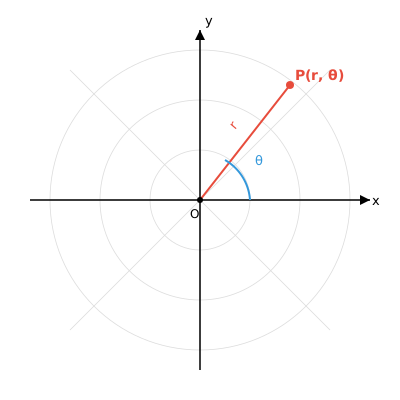
Key Observations:
A point in polar coordinates can be converted to Cartesian coordinates using:
Conversely, Cartesian coordinates can be converted to polar coordinates using:
Multiple polar coordinates can represent the same point:
Example: Converting Between Coordinate Systems
Section titled “Example: Converting Between Coordinate Systems”Convert the following points between polar and Cartesian coordinates:
(a) The polar point to Cartesian coordinates
(b) The Cartesian point to polar coordinates
Module 2: Basic Polar Curves
Section titled “Module 2: Basic Polar Curves”Case 1: (Rays)
Section titled “Case 1: θ=a\theta = aθ=a (Rays)”The equation represents a ray (half-line) starting from the origin and making an angle with the positive -axis.
Cartesian Equivalent:
with the constraint that the point must lie in the appropriate quadrant determined by .
Case 2: (Circles)
Section titled “Case 2: r=ar = ar=a (Circles)”The equation , where , represents a circle centred at the origin with radius .
Cartesian Equivalent:
The equation represents a straight line that is at distance from the origin, with the perpendicular to the line making an angle with the positive -axis.
Characteristics:
- The line is at a perpendicular distance from the origin
- The normal from the origin to the line makes an angle with the positive -axis
Example: Identifying and Sketching Basic Polar Curves
Section titled “Example: Identifying and Sketching Basic Polar Curves”Identify and sketch the following polar curves:
(a)
(b)
(c)
Module 3: Special Polar Curves
Section titled “Module 3: Special Polar Curves”Case 4: (Circles through the Origin)
Section titled “Case 4: r=2acosθr = 2a\cos\thetar=2acosθ (Circles through the Origin)”The equation represents a circle with diameter , passing through the origin, with centre at .
Characteristics:
- The circle is traversed as varies from to where is non-negative.
Cartesian Equivalent:
Case 5: (Spirals of Archimedes)
Section titled “Case 5: r=kθr = k\thetar=kθ (Spirals of Archimedes)”The equation represents an Archimedean spiral, where the distance from the origin increases linearly with the angle.
Case 6: (Cardioids)
Section titled “Case 6: r=a(1±cosθ)r = a(1 \pm \cos\theta)r=a(1±cosθ) (Cardioids)”The equations and represent cardioids (“heart-shaped” curves).
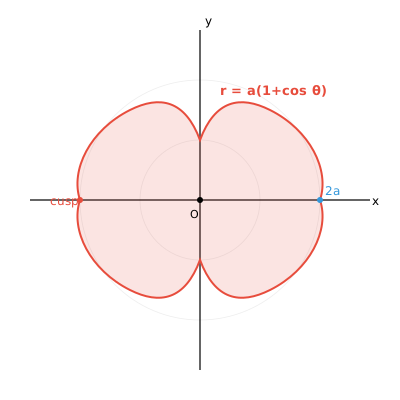
Characteristics:
- The cardioid has a cusp (sharp point) at for and at for
- The maximum distance from the origin is (occurring at for the first curve and for the second)
- The curve resembles a heart or kidney shape
- The cardioid can be generated as the path traced by a point on a circle as it rolls around another circle of the same radius
Case 7: (Limaçons)
Section titled “Case 7: r=a(3+2cosθ)r = a(3 + 2\cos\theta)r=a(3+2cosθ) (Limaçons)”The equation represents a limaçon without an inner loop.
Characteristics:
- This is a limaçon without an inner loop (since )
- The curve is symmetric about the -axis
Case 8: (Lemniscate of Bernoulli)
Section titled “Case 8: r2=a2cos2θr^2 = a^2\cos 2\thetar2=a2cos2θ (Lemniscate of Bernoulli)”The equation represents a lemniscate of Bernoulli.
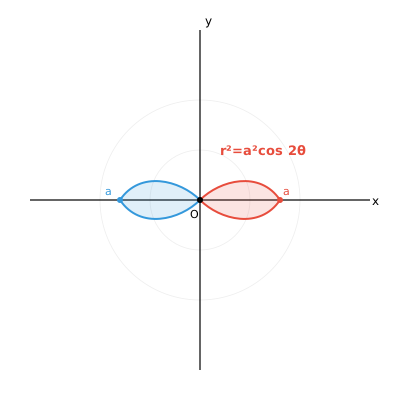
Characteristics:
- The curve passes through the origin (which is a self-intersection point)
- The curve has two loops, each extending a distance from the origin
- The curve exists only when , i.e., for in or
Module 4: Computing Areas in Polar Coordinates
Section titled “Module 4: Computing Areas in Polar Coordinates”Key Concept: Area Formula in Polar Coordinates
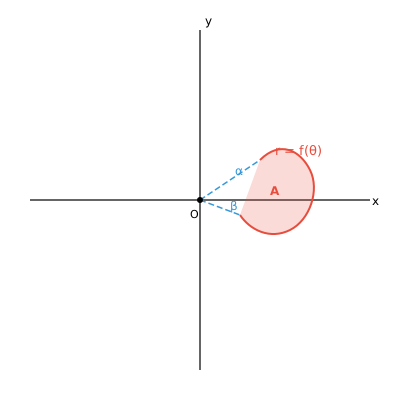
Section titled “Key Concept: Area Formula in Polar Coordinates”The area of a region in polar coordinates is given by:
where the region is bounded by:
- The rays and
- The curve
- The origin
Example: Area of a Circle
Section titled “Example: Area of a Circle”Find the area of a circle with radius using polar coordinates.
Solution:
In polar coordinates, a circle of radius centred at the origin is given by the equation . The area is:
This confirms the well-known formula for the area of a circle.
Example: Area of a Cardioid
Section titled “Example: Area of a Cardioid”Find the area enclosed by the cardioid .
Solution:
We need to integrate over the entire curve, which spans from to :
Using the identity :
Evaluating the integral:
Therefore, the area enclosed by the cardioid is .
Example: Area Between Curves
Section titled “Example: Area Between Curves”Find the area of the region that lies inside the circle and outside the cardioid .
Module 5: Tangents and Slopes in Polar Coordinates
Section titled “Module 5: Tangents and Slopes in Polar Coordinates”Key Concept: Finding Slopes of Tangent Lines
Section titled “Key Concept: Finding Slopes of Tangent Lines”For a curve given by in polar coordinates, the slope of the tangent line at a point is:
where is the derivative of with respect to .
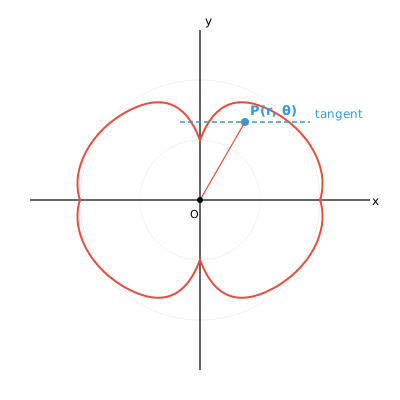
Derivation:
The parametric equations for a polar curve are:
Differentiating with respect to :
The slope of the tangent line is:
Example: Finding the Slope at a Point
Section titled “Example: Finding the Slope at a Point”Find the slope of the tangent line to the cardioid at the point where .
Solution:
First, we need to find and at :
Now, we can calculate the slope:
Therefore, the tangent line at the point where is horizontal.
Finding Points with Horizontal and Vertical Tangents
Section titled “Finding Points with Horizontal and Vertical Tangents”For a curve :
Horizontal Tangents (where ):
Vertical Tangents (where ):
These equations can be used to find special points on polar curves.
Comprehensive Exercise: Tangents and Areas
Section titled “Comprehensive Exercise: Tangents and Areas”Solution (a):
For the curve , we need to find where the tangent is horizontal. For a polar curve, horizontal tangents occur when:
Let’s find :
Substituting into the horizontal tangent condition:
Factoring out :
This means either:
- , which occurs at and , or
- , which means
The second condition gives us and in the interval .
Solution (b):
Key points on the curve:
| Note | ||
|---|---|---|
| horizontal tangent | ||
| horizontal tangent | ||
| horizontal tangent | ||
| horizontal tangent |
Solution (c):
The horizontal tangents in the range are at and .
Using the area formula in polar coordinates:
Expanding the integrand:
Using the identity :
Therefore:
Evaluating at the limits:
At : , ,
At : , ,
Substituting:
Therefore, the area of the region is square units.