In previous courses, we have studied 2×2 matrices and their properties. In this lecture, we’ll extend our understanding to 3×3 matrices, which are crucial in solving systems of linear equations with three variables, 3D transformations, and various applications in physics and engineering.
3×3 matrices have numerous applications across different fields:
Solving systems of three linear equations with three variables
Representing 3D transformations in computer graphics and animation
Analyzing structural problems in engineering
Quantum mechanics calculations in physics
Economic models with three interrelated factors
Network analysis in computer science
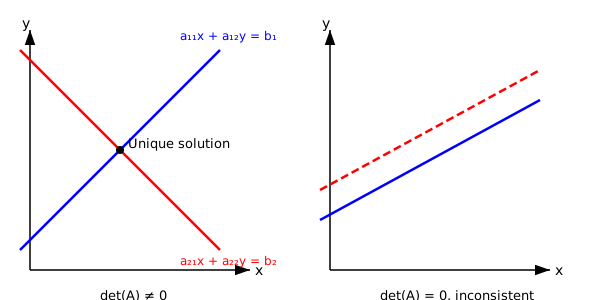
A system of two linear equations with two variables can be represented as:
a 11 x 1 + a 12 x 2 = b 1 a 21 x 1 + a 22 x 2 = b 2 \begin{aligned}
a_{11}x_1 + a_{12}x_2 &= b_1 \\
a_{21}x_1 + a_{22}x_2 &= b_2
\end{aligned} a 11 x 1 + a 12 x 2 a 21 x 1 + a 22 x 2 = b 1 = b 2 This can be written in matrix form as A x = b A\mathbf{x} = \mathbf{b} A x = b A A A x \mathbf{x} x b \mathbf{b} b
Definition. The determinant of a 2×2 matrix A = ( a b c d ) A = \begin{pmatrix} a & b \\ c & d \end{pmatrix} A = ( a c b d )
det ( A ) = ∣ A ∣ = a d − b c \det(A) = |A| = ad - bc det ( A ) = ∣ A ∣ = a d − b c Theorem. For a system of linear equations represented by the matrix equation A x = b A\mathbf{x} = \mathbf{b} A x = b
If det ( A ) ≠ 0 \det(A) \neq 0 det ( A ) = 0
If det ( A ) = 0 \det(A) = 0 det ( A ) = 0
If det ( A ) = 0 \det(A) = 0 det ( A ) = 0
For a 2×2 matrix A = ( a b c d ) A = \begin{pmatrix} a & b \\ c & d \end{pmatrix} A = ( a c b d ) det ( A ) ≠ 0 \det(A) \neq 0 det ( A ) = 0
A − 1 = 1 a d − b c ( d − b − c a ) A^{-1} = \frac{1}{ad-bc} \begin{pmatrix} d & -b \\ -c & a \end{pmatrix} A − 1 = a d − b c 1 ( d − c − b a ) If det ( A ) ≠ 0 \det(A) \neq 0 det ( A ) = 0 A x = b A\mathbf{x} = \mathbf{b} A x = b x = A − 1 b \mathbf{x} = A^{-1}\mathbf{b} x = A − 1 b
Solve the system:
3 x + 2 y = 7 x − y = 2 \begin{aligned}
3x + 2y &= 7 \\
x - y &= 2
\end{aligned} 3 x + 2 y x − y = 7 = 2 Solution: A = ( 3 2 1 − 1 ) A = \begin{pmatrix} 3 & 2 \\ 1 & -1 \end{pmatrix} A = ( 3 1 2 − 1 ) b = ( 7 2 ) \mathbf{b} = \begin{pmatrix} 7 \\ 2 \end{pmatrix} b = ( 7 2 )
det ( A ) = − 3 − 2 = − 5 ≠ 0 \det(A) = -3 - 2 = -5 \neq 0 det ( A ) = − 3 − 2 = − 5 = 0
A − 1 = 1 − 5 ( − 1 − 2 − 1 3 ) = ( 1 5 2 5 1 5 − 3 5 ) A^{-1} = \frac{1}{-5} \begin{pmatrix} -1 & -2 \\ -1 & 3 \end{pmatrix} = \begin{pmatrix} \frac{1}{5} & \frac{2}{5} \\ \frac{1}{5} & -\frac{3}{5} \end{pmatrix} A − 1 = − 5 1 ( − 1 − 1 − 2 3 ) = ( 5 1 5 1 5 2 − 5 3 ) x = A − 1 b = ( 11 5 1 5 ) \mathbf{x} = A^{-1}\mathbf{b} = \begin{pmatrix} \frac{11}{5} \\ \frac{1}{5} \end{pmatrix} x = A − 1 b = ( 5 11 5 1 ) So x = 11 5 x = \frac{11}{5} x = 5 11 y = 1 5 y = \frac{1}{5} y = 5 1
For any invertible matrix A A A
A A − 1 = A − 1 A = I A A^{-1} = A^{-1} A = I A A − 1 = A − 1 A = I ( A − 1 ) − 1 = A (A^{-1})^{-1} = A ( A − 1 ) − 1 = A ( A B ) − 1 = B − 1 A − 1 (AB)^{-1} = B^{-1}A^{-1} ( A B ) − 1 = B − 1 A − 1 ( A T ) − 1 = ( A − 1 ) T (A^T)^{-1} = (A^{-1})^T ( A T ) − 1 = ( A − 1 ) T
A system of three linear equations with three variables can be written as A x = b A\mathbf{x} = \mathbf{b} A x = b A A A
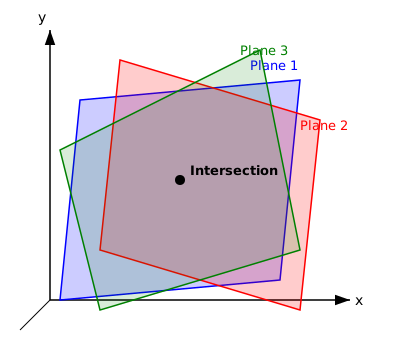
Geometrically, each equation represents a plane in 3D space, and the solution(s) to the system represent the point(s) where all three planes intersect.
Definition. For a 3×3 matrix A = ( a 11 a 12 a 13 a 21 a 22 a 23 a 31 a 32 a 33 ) A = \begin{pmatrix} a_{11} & a_{12} & a_{13} \\ a_{21} & a_{22} & a_{23} \\ a_{31} & a_{32} & a_{33} \end{pmatrix} A = a 11 a 21 a 31 a 12 a 22 a 32 a 13 a 23 a 33
det ( A ) = a 11 ∣ a 22 a 23 a 32 a 33 ∣ − a 12 ∣ a 21 a 23 a 31 a 33 ∣ + a 13 ∣ a 21 a 22 a 31 a 32 ∣ \begin{aligned}
\det(A) &= a_{11}\begin{vmatrix} a_{22} & a_{23} \\ a_{32} & a_{33} \end{vmatrix} - a_{12}\begin{vmatrix} a_{21} & a_{23} \\ a_{31} & a_{33} \end{vmatrix} + a_{13}\begin{vmatrix} a_{21} & a_{22} \\ a_{31} & a_{32} \end{vmatrix}
\end{aligned} det ( A ) = a 11 a 22 a 32 a 23 a 33 − a 12 a 21 a 31 a 23 a 33 + a 13 a 21 a 31 a 22 a 32
There are several methods to compute the determinant of a 3×3 matrix:
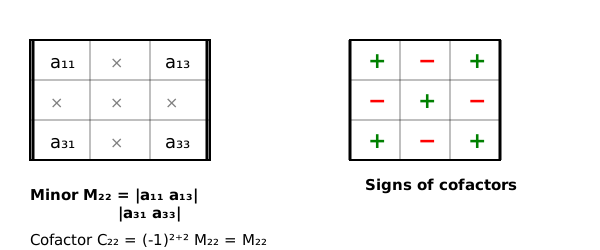
Expansion by minors along any row or column:
det ( A ) = a i 1 M i 1 − a i 2 M i 2 + a i 3 M i 3 \det(A) = a_{i1}M_{i1} - a_{i2}M_{i2} + a_{i3}M_{i3} det ( A ) = a i 1 M i 1 − a i 2 M i 2 + a i 3 M i 3 where M i j M_{ij} M ij a i j a_{ij} a ij i i i j j j
Theorem. As with 2×2 matrices, the determinant of a 3×3 matrix determines the nature of solutions:
If det ( A ) ≠ 0 \det(A) \neq 0 det ( A ) = 0
If det ( A ) = 0 \det(A) = 0 det ( A ) = 0
If det ( A ) = 0 \det(A) = 0 det ( A ) = 0
When we view the columns of matrix A A A det ( A ) ≠ 0 \det(A) \neq 0 det ( A ) = 0 b \mathbf{b} b
When det ( A ) = 0 \det(A) = 0 det ( A ) = 0
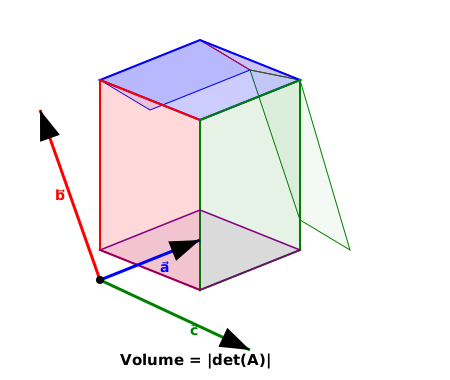
For a 3×3 matrix, the absolute value of the determinant gives the volume of the parallelepiped formed by its column vectors.
When det ( A ) = 0 \det(A) = 0 det ( A ) = 0
(a) Calculate the determinant of ( 2 1 3 0 − 1 2 1 0 4 ) \begin{pmatrix} 2 & 1 & 3 \\ 0 & -1 & 2 \\ 1 & 0 & 4 \end{pmatrix} 2 0 1 1 − 1 0 3 2 4
(b) Using the determinant, determine whether the system below has a unique solution, infinitely many solutions, or no solution:
2 x + y + 3 z = 4 − x + 2 y − z = 3 x + 3 y + 2 z = 1 \begin{aligned}
2x + y + 3z &= 4 \\
-x + 2y - z &= 3 \\
x + 3y + 2z &= 1
\end{aligned} 2 x + y + 3 z − x + 2 y − z x + 3 y + 2 z = 4 = 3 = 1 (c) Interpret geometrically what it means if the determinant of a 3×3 matrix is zero.
Definition. The cofactor C i j C_{ij} C ij a i j a_{ij} a ij ( − 1 ) i + j (-1)^{i+j} ( − 1 ) i + j i i i j j j
The adjugate (or classical adjoint) of a matrix A A A
adj ( A ) = ( C 11 C 21 C 31 C 12 C 22 C 32 C 13 C 23 C 33 ) \text{adj}(A) =
\begin{pmatrix}
C_{11} & C_{21} & C_{31} \\
C_{12} & C_{22} & C_{32} \\
C_{13} & C_{23} & C_{33}
\end{pmatrix} adj ( A ) = C 11 C 12 C 13 C 21 C 22 C 23 C 31 C 32 C 33 For a 3×3 matrix A A A det ( A ) ≠ 0 \det(A) \neq 0 det ( A ) = 0
A − 1 = 1 det ( A ) ⋅ adj ( A ) A^{-1} = \frac{1}{\det(A)} \cdot \text{adj}(A) A − 1 = det ( A ) 1 ⋅ adj ( A )
A matrix is not invertible (singular) if and only if its determinant is zero. This happens when:
One row or column is a multiple of another
One row or column contains only zeros
One row or column is a linear combination of others
Geometrically, a singular 3×3 matrix represents a transformation that collapses 3D space onto a plane or a line.
Once we have the inverse, we can solve the system using x = A − 1 b \mathbf{x} = A^{-1}\mathbf{b} x = A − 1 b
Solve the system:
x + 2 y + z = 5 3 x + 2 y + z = 7 2 x + y + 2 z = 8 \begin{aligned}
x + 2y + z &= 5 \\
3x + 2y + z &= 7 \\
2x + y + 2z &= 8
\end{aligned} x + 2 y + z 3 x + 2 y + z 2 x + y + 2 z = 5 = 7 = 8 Using the inverse matrix from the previous example:
x = A − 1 b = ( 1 2 3 8 3 ) \mathbf{x} = A^{-1}\mathbf{b} = \begin{pmatrix} 1 \\ \frac{2}{3} \\ \frac{8}{3} \end{pmatrix} x = A − 1 b = 1 3 2 3 8 Therefore, x = 1 x = 1 x = 1 y = 2 3 y = \frac{2}{3} y = 3 2 z = 8 3 z = \frac{8}{3} z = 3 8
While the cofactor method provides a clear formula, it is computationally intensive for larger matrices. Gaussian elimination (row reduction) is more efficient for practical applications.
To find the inverse of a matrix A A A
Create an augmented matrix [ A ∣ I ] [A|I] [ A ∣ I ] I I I
Apply elementary row operations to transform the left side into the identity matrix
The resulting right side will be A − 1 A^{-1} A − 1
Find the inverse of A = ( 1 2 1 3 2 1 2 1 2 ) A = \begin{pmatrix} 1 & 2 & 1 \\ 3 & 2 & 1 \\ 2 & 1 & 2 \end{pmatrix} A = 1 3 2 2 2 1 1 1 2
Starting with the augmented matrix [ A ∣ I ] [A|I] [ A ∣ I ]
[ 1 2 1 1 0 0 3 2 1 0 1 0 2 1 2 0 0 1 ] \left[\begin{array}{ccc|ccc}
1 & 2 & 1 & 1 & 0 & 0 \\
3 & 2 & 1 & 0 & 1 & 0 \\
2 & 1 & 2 & 0 & 0 & 1
\end{array}\right] 1 3 2 2 2 1 1 1 2 1 0 0 0 1 0 0 0 1 After applying row operations:
[ 1 0 0 − 1 2 1 2 0 0 1 0 2 3 0 − 1 3 0 0 1 1 6 − 1 2 2 3 ] \left[\begin{array}{ccc|ccc}
1 & 0 & 0 & -\frac{1}{2} & \frac{1}{2} & 0 \\
0 & 1 & 0 & \frac{2}{3} & 0 & -\frac{1}{3} \\
0 & 0 & 1 & \frac{1}{6} & -\frac{1}{2} & \frac{2}{3}
\end{array}\right] 1 0 0 0 1 0 0 0 1 − 2 1 3 2 6 1 2 1 0 − 2 1 0 − 3 1 3 2 This matches our result from the cofactor method.
(a) Use the cofactor method to find the inverse of ( 2 1 0 1 3 1 0 2 2 ) \begin{pmatrix} 2 & 1 & 0 \\ 1 & 3 & 1 \\ 0 & 2 & 2 \end{pmatrix} 2 1 0 1 3 2 0 1 2
(b) Write the system as a matrix equation and solve using the inverse:
2 x + y − z = 5 x + 2 y + z = 8 x + y + 3 z = 10 \begin{aligned}
2x + y - z &= 5 \\
x + 2y + z &= 8 \\
x + y + 3z &= 10
\end{aligned} 2 x + y − z x + 2 y + z x + y + 3 z = 5 = 8 = 10 (c) Explain why the matrix ( 1 2 3 2 4 6 3 6 9 ) \begin{pmatrix} 1 & 2 & 3 \\ 2 & 4 & 6 \\ 3 & 6 & 9 \end{pmatrix} 1 2 3 2 4 6 3 6 9
Definition. The transpose of a matrix A A A A T A^T A T A A A
( A T ) T = A (A^T)^T = A ( A T ) T = A ( A + B ) T = A T + B T (A + B)^T = A^T + B^T ( A + B ) T = A T + B T ( A B ) T = B T A T (AB)^T = B^T A^T ( A B ) T = B T A T det ( A T ) = det ( A ) \det(A^T) = \det(A) det ( A T ) = det ( A ) If A A A ( A T ) − 1 = ( A − 1 ) T (A^T)^{-1} = (A^{-1})^T ( A T ) − 1 = ( A − 1 ) T
Definition. A square matrix Q Q Q
Q T = Q − 1 or equivalently Q T Q = Q Q T = I Q^T = Q^{-1} \quad \text{or equivalently} \quad Q^T Q = Q Q^T = I Q T = Q − 1 or equivalently Q T Q = Q Q T = I
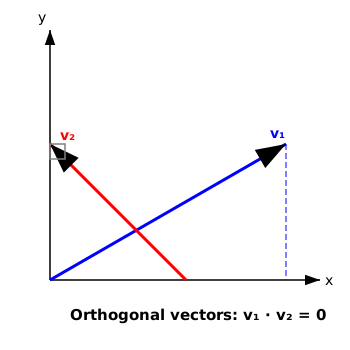
A matrix Q Q Q
Each row vector has norm (length) equal to 1
Any two different row vectors are orthogonal to each other
For a 3×3 matrix Q Q Q r 1 \mathbf{r}_1 r 1 r 2 \mathbf{r}_2 r 2 r 3 \mathbf{r}_3 r 3
r 1 ⋅ r 1 = r 2 ⋅ r 2 = r 3 ⋅ r 3 = 1 r 1 ⋅ r 2 = r 1 ⋅ r 3 = r 2 ⋅ r 3 = 0 \begin{aligned}
\mathbf{r}_1 \cdot \mathbf{r}_1 = \mathbf{r}_2 \cdot \mathbf{r}_2 = \mathbf{r}_3 \cdot \mathbf{r}_3 &= 1 \\
\mathbf{r}_1 \cdot \mathbf{r}_2 = \mathbf{r}_1 \cdot \mathbf{r}_3 = \mathbf{r}_2 \cdot \mathbf{r}_3 &= 0
\end{aligned} r 1 ⋅ r 1 = r 2 ⋅ r 2 = r 3 ⋅ r 3 r 1 ⋅ r 2 = r 1 ⋅ r 3 = r 2 ⋅ r 3 = 1 = 0
Theorem. For any orthogonal matrix Q Q Q
det ( Q ) = ± 1 \det(Q) = \pm 1 det ( Q ) = ± 1 If det ( Q ) = 1 \det(Q) = 1 det ( Q ) = 1 Q Q Q
If det ( Q ) = − 1 \det(Q) = -1 det ( Q ) = − 1 Q Q Q
If Q Q Q Q − 1 = Q T Q^{-1} = Q^T Q − 1 = Q T
This means to find the inverse of an orthogonal matrix, you simply take its transpose! This is a significant computational advantage.
Determine if the following matrix is orthogonal, and if so, find its inverse:
Q = ( 1 2 1 2 0 − 1 2 1 2 0 0 0 1 ) Q = \begin{pmatrix} \frac{1}{\sqrt{2}} & \frac{1}{\sqrt{2}} & 0 \\ -\frac{1}{\sqrt{2}} & \frac{1}{\sqrt{2}} & 0 \\ 0 & 0 & 1 \end{pmatrix} Q = 2 1 − 2 1 0 2 1 2 1 0 0 0 1 Solution: Checking that all rows are unit vectors and orthogonal to each other confirms Q Q Q
Q − 1 = Q T = ( 1 2 − 1 2 0 1 2 1 2 0 0 0 1 ) Q^{-1} = Q^T = \begin{pmatrix} \frac{1}{\sqrt{2}} & -\frac{1}{\sqrt{2}} & 0 \\ \frac{1}{\sqrt{2}} & \frac{1}{\sqrt{2}} & 0 \\ 0 & 0 & 1 \end{pmatrix} Q − 1 = Q T = 2 1 2 1 0 − 2 1 2 1 0 0 0 1
1. Rotation matrices in 3D space are orthogonal matrices with determinant 1:
Rotation around the x-axis by angle θ \theta θ
R x ( θ ) = ( 1 0 0 0 cos θ − sin θ 0 sin θ cos θ ) R_x(\theta) = \begin{pmatrix} 1 & 0 & 0 \\ 0 & \cos\theta & -\sin\theta \\ 0 & \sin\theta & \cos\theta \end{pmatrix} R x ( θ ) = 1 0 0 0 cos θ sin θ 0 − sin θ cos θ Rotation around the y-axis by angle θ \theta θ
R y ( θ ) = ( cos θ 0 sin θ 0 1 0 − sin θ 0 cos θ ) R_y(\theta) = \begin{pmatrix} \cos\theta & 0 & \sin\theta \\ 0 & 1 & 0 \\ -\sin\theta & 0 & \cos\theta \end{pmatrix} R y ( θ ) = cos θ 0 − sin θ 0 1 0 sin θ 0 cos θ Rotation around the z-axis by angle θ \theta θ
R z ( θ ) = ( cos θ − sin θ 0 sin θ cos θ 0 0 0 1 ) R_z(\theta) = \begin{pmatrix} \cos\theta & -\sin\theta & 0 \\ \sin\theta & \cos\theta & 0 \\ 0 & 0 & 1 \end{pmatrix} R z ( θ ) = cos θ sin θ 0 − sin θ cos θ 0 0 0 1 2. Reflection matrices are orthogonal matrices with determinant -1. For example, reflection across the xy-plane:
R x y = ( 1 0 0 0 1 0 0 0 − 1 ) R_{xy} = \begin{pmatrix} 1 & 0 & 0 \\ 0 & 1 & 0 \\ 0 & 0 & -1 \end{pmatrix} R x y = 1 0 0 0 1 0 0 0 − 1
(a) Find the transpose of ( 3 − 1 4 2 0 5 1 7 − 2 ) \begin{pmatrix} 3 & -1 & 4 \\ 2 & 0 & 5 \\ 1 & 7 & -2 \end{pmatrix} 3 2 1 − 1 0 7 4 5 − 2
(b) Verify whether ( 3 5 4 5 0 − 4 5 3 5 0 0 0 1 ) \begin{pmatrix} \frac{3}{5} & \frac{4}{5} & 0 \\ -\frac{4}{5} & \frac{3}{5} & 0 \\ 0 & 0 & 1 \end{pmatrix} 5 3 − 5 4 0 5 4 5 3 0 0 0 1
(c) If a 3×3 matrix Q Q Q det ( Q ) = − 1 \det(Q) = -1 det ( Q ) = − 1
When a line r ( t ) = r 0 + t v \mathbf{r}(t) = \mathbf{r}_0 + t\mathbf{v} r ( t ) = r 0 + t v A A A
T ( r ( t ) ) = A r 0 + t A v T(\mathbf{r}(t)) = A\mathbf{r}_0 + tA\mathbf{v} T ( r ( t )) = A r 0 + t A v This means:
The point r 0 \mathbf{r}_0 r 0 A r 0 A\mathbf{r}_0 A r 0
The direction vector v \mathbf{v} v A v A\mathbf{v} A v
Note: If A A A A v = 0 A\mathbf{v} = \mathbf{0} A v = 0 A r 0 A\mathbf{r}_0 A r 0
The line L L L x = 1 + 2 t x = 1 + 2t x = 1 + 2 t y = 3 − t y = 3 - t y = 3 − t z = 2 t z = 2t z = 2 t A = ( 2 0 0 0 3 0 0 0 1 ) A = \begin{pmatrix} 2 & 0 & 0 \\ 0 & 3 & 0 \\ 0 & 0 & 1 \end{pmatrix} A = 2 0 0 0 3 0 0 0 1
Solution:
r 0 ′ = A r 0 = ( 2 9 1 ) , v ′ = A v = ( 4 − 3 4 ) \mathbf{r}_0' = A\mathbf{r}_0 = \begin{pmatrix} 2 \\ 9 \\ 1 \end{pmatrix}, \quad
\mathbf{v}' = A\mathbf{v} = \begin{pmatrix} 4 \\ -3 \\ 4 \end{pmatrix} r 0 ′ = A r 0 = 2 9 1 , v ′ = A v = 4 − 3 4 The transformed line is:
r ′ ( t ) = ( 2 9 1 ) + t ( 4 − 3 4 ) \mathbf{r}'(t) = \begin{pmatrix} 2 \\ 9 \\ 1 \end{pmatrix} + t\begin{pmatrix} 4 \\ -3 \\ 4 \end{pmatrix} r ′ ( t ) = 2 9 1 + t 4 − 3 4 In symmetric form: x − 2 4 = y − 9 − 3 = z − 1 4 \frac{x-2}{4} = \frac{y-9}{-3} = \frac{z-1}{4} 4 x − 2 = − 3 y − 9 = 4 z − 1
When a plane Π 1 \Pi_1 Π 1 M \mathbf{M} M Π 2 \Pi_2 Π 2
1. Using the parametric form:
T ( r ( s , t ) ) = A r 0 + s A v 1 + t A v 2 T(\mathbf{r}(s,t)) = A\mathbf{r}_0 + sA\mathbf{v}_1 + tA\mathbf{v}_2 T ( r ( s , t )) = A r 0 + s A v 1 + t A v 2 2. Using the inverse transformation method:
If ( x , y , z ) (x,y,z) ( x , y , z ) Π 1 \Pi_1 Π 1 ( u , v , w ) (u,v,w) ( u , v , w ) Π 2 \Pi_2 Π 2 M \mathbf{M} M M − 1 \mathbf{M}^{-1} M − 1 ( x , y , z ) (x,y,z) ( x , y , z ) ( u , v , w ) (u,v,w) ( u , v , w ) Π 1 \Pi_1 Π 1
Consider the plane 3 x − 7 y + 2 z = − 3 3x - 7y + 2z = -3 3 x − 7 y + 2 z = − 3 M = ( 2 0 0 0 1 0 0 0 3 ) \mathbf{M} = \begin{pmatrix} 2 & 0 & 0 \\ 0 & 1 & 0 \\ 0 & 0 & 3 \end{pmatrix} M = 2 0 0 0 1 0 0 0 3
M − 1 = ( 1 2 0 0 0 1 0 0 0 1 3 ) \mathbf{M}^{-1} = \begin{pmatrix} \frac{1}{2} & 0 & 0 \\ 0 & 1 & 0 \\ 0 & 0 & \frac{1}{3} \end{pmatrix} M − 1 = 2 1 0 0 0 1 0 0 0 3 1 So x = 1 2 u x = \frac{1}{2}u x = 2 1 u y = v y = v y = v z = 1 3 w z = \frac{1}{3}w z = 3 1 w
3 2 u − 7 v + 2 3 w = − 3 ⟹ 9 u − 42 v + 4 w = − 18 \frac{3}{2}u - 7v + \frac{2}{3}w = -3 \implies 9u - 42v + 4w = -18 2 3 u − 7 v + 3 2 w = − 3 ⟹ 9 u − 42 v + 4 w = − 18
Let M = ( 2 0 0 0 1 4 3 − 2 − 3 ) \mathbf{M} = \begin{pmatrix} 2 & 0 & 0 \\ 0 & 1 & 4 \\ 3 & -2 & -3 \end{pmatrix} M = 2 0 3 0 1 − 2 0 4 − 3
(a) Determine M − 1 \mathbf{M}^{-1} M − 1
The transformation represented by M \mathbf{M} M Π 1 \Pi_1 Π 1 Π 2 \Pi_2 Π 2 ( x , y , z ) (x, y, z) ( x , y , z ) Π 1 \Pi_1 Π 1 ( u , v , w ) (u, v, w) ( u , v , w ) Π 2 \Pi_2 Π 2
(b) Determine x x x y y y z z z u u u v v v w w w
The plane Π 1 \Pi_1 Π 1 3 x − 7 y + 2 z = − 3 3x - 7y + 2z = -3 3 x − 7 y + 2 z = − 3
(c) Find a Cartesian equation for Π 2 \Pi_2 Π 2 a u + b v + c w = d au + bv + cw = d a u + b v + c w = d a a a b b b c c c d d d
How would you compute A 100 A^{100} A 100 A A A
Diagonalization provides the answer. If A = P D P − 1 A = PDP^{-1} A = P D P − 1 D D D
A n = P D n P − 1 A^n = PD^nP^{-1} A n = P D n P − 1 And since D D D λ 1 , λ 2 , … , λ n \lambda_1, \lambda_2, \ldots, \lambda_n λ 1 , λ 2 , … , λ n
D n = ( λ 1 n 0 ⋯ 0 0 λ 2 n ⋯ 0 ⋮ ⋮ ⋱ ⋮ 0 0 ⋯ λ n n ) D^n = \begin{pmatrix} \lambda_1^n & 0 & \cdots & 0 \\ 0 & \lambda_2^n & \cdots & 0 \\ \vdots & \vdots & \ddots & \vdots \\ 0 & 0 & \cdots & \lambda_n^n \end{pmatrix} D n = λ 1 n 0 ⋮ 0 0 λ 2 n ⋮ 0 ⋯ ⋯ ⋱ ⋯ 0 0 ⋮ λ n n This means we can compute A 100 A^{100} A 100 A 1000 A^{1000} A 1000
Definition. For a square matrix A A A v \mathbf{v} v eigenvector of A A A λ \lambda λ eigenvalue ) such that:
A v = λ v A\mathbf{v} = \lambda\mathbf{v} A v = λ v
Start with the equation A v = λ v A\mathbf{v} = \lambda\mathbf{v} A v = λ v
Rearrange to ( A − λ I ) v = 0 (A - \lambda I)\mathbf{v} = \mathbf{0} ( A − λ I ) v = 0
For non-zero solutions, we need det ( A − λ I ) = 0 \det(A - \lambda I) = 0 det ( A − λ I ) = 0
Solve this characteristic equation to find the eigenvalues λ \lambda λ
For each eigenvalue, find the corresponding eigenvectors by solving ( A − λ I ) v = 0 (A - \lambda I)\mathbf{v} = \mathbf{0} ( A − λ I ) v = 0
Eigenvalues and Eigenvectors of 2×2 Matrices
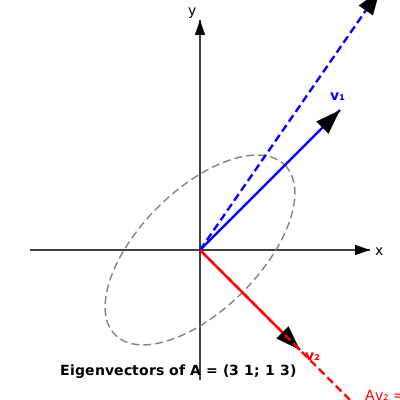
Find the eigenvalues and eigenvectors of A = ( 3 1 1 3 ) A = \begin{pmatrix} 3 & 1 \\ 1 & 3 \end{pmatrix} A = ( 3 1 1 3 )
Step 1: Characteristic equation:
det ( A − λ I ) = ( 3 − λ ) 2 − 1 = λ 2 − 6 λ + 8 = ( λ − 4 ) ( λ − 2 ) = 0 \det(A - \lambda I) = (3-\lambda)^2 - 1 = \lambda^2 - 6\lambda + 8 = (\lambda-4)(\lambda-2) = 0 det ( A − λ I ) = ( 3 − λ ) 2 − 1 = λ 2 − 6 λ + 8 = ( λ − 4 ) ( λ − 2 ) = 0 Eigenvalues: λ 1 = 4 \lambda_1 = 4 λ 1 = 4 λ 2 = 2 \lambda_2 = 2 λ 2 = 2
Step 2: For λ 1 = 4 \lambda_1 = 4 λ 1 = 4 ( A − 4 I ) v = 0 (A - 4I)\mathbf{v} = \mathbf{0} ( A − 4 I ) v = 0 v 1 = v 2 v_1 = v_2 v 1 = v 2 v 1 = ( 1 1 ) \mathbf{v}_1 = \begin{pmatrix} 1 \\ 1 \end{pmatrix} v 1 = ( 1 1 )
Step 3: For λ 2 = 2 \lambda_2 = 2 λ 2 = 2 ( A − 2 I ) v = 0 (A - 2I)\mathbf{v} = \mathbf{0} ( A − 2 I ) v = 0 v 1 = − v 2 v_1 = -v_2 v 1 = − v 2 v 2 = ( 1 − 1 ) \mathbf{v}_2 = \begin{pmatrix} 1 \\ -1 \end{pmatrix} v 2 = ( 1 − 1 )
Eigenvalues and Eigenvectors of 3×3 Matrices
Find the eigenvalues and one eigenvector for each eigenvalue of A = ( 2 0 0 0 3 4 0 4 9 ) A = \begin{pmatrix} 2 & 0 & 0 \\ 0 & 3 & 4 \\ 0 & 4 & 9 \end{pmatrix} A = 2 0 0 0 3 4 0 4 9
Step 1: Characteristic polynomial:
det ( A − λ I ) = ( 2 − λ ) [ ( 3 − λ ) ( 9 − λ ) − 16 ] = ( 2 − λ ) ( λ 2 − 12 λ + 11 ) \det(A - \lambda I) = (2-\lambda)[(3-\lambda)(9-\lambda) - 16] = (2-\lambda)(\lambda^2 - 12\lambda + 11) det ( A − λ I ) = ( 2 − λ ) [( 3 − λ ) ( 9 − λ ) − 16 ] = ( 2 − λ ) ( λ 2 − 12 λ + 11 ) Step 2: Eigenvalues: λ 1 = 2 \lambda_1 = 2 λ 1 = 2 λ 2 = 11 \lambda_2 = 11 λ 2 = 11 λ 3 = 1 \lambda_3 = 1 λ 3 = 1
Step 3: Eigenvectors:
λ 1 = 2 : v 1 = ( 1 0 0 ) λ 2 = 11 : v 2 = ( 0 1 2 ) λ 3 = 1 : v 3 = ( 0 2 − 1 ) \begin{aligned}
\lambda_1 = 2 &: \mathbf{v}_1 = \begin{pmatrix} 1 \\ 0 \\ 0 \end{pmatrix} \\
\lambda_2 = 11 &: \mathbf{v}_2 = \begin{pmatrix} 0 \\ 1 \\ 2 \end{pmatrix} \\
\lambda_3 = 1 &: \mathbf{v}_3 = \begin{pmatrix} 0 \\ 2 \\ -1 \end{pmatrix}
\end{aligned} λ 1 = 2 λ 2 = 11 λ 3 = 1 : v 1 = 1 0 0 : v 2 = 0 1 2 : v 3 = 0 2 − 1
The determinant of a matrix equals the product of its eigenvalues: det ( A ) = λ 1 λ 2 ⋯ λ n \det(A) = \lambda_1 \lambda_2 \cdots \lambda_n det ( A ) = λ 1 λ 2 ⋯ λ n
The trace of a matrix equals the sum of its eigenvalues: tr ( A ) = λ 1 + λ 2 + ⋯ + λ n \text{tr}(A) = \lambda_1 + \lambda_2 + \cdots + \lambda_n tr ( A ) = λ 1 + λ 2 + ⋯ + λ n
The trace is the sum of the elements on the main diagonal: tr ( A ) = a 11 + a 22 + ⋯ + a n n \text{tr}(A) = a_{11} + a_{22} + \cdots + a_{nn} tr ( A ) = a 11 + a 22 + ⋯ + a nn
A matrix A A A diagonalizable if it can be written as A = P D P − 1 A = PDP^{-1} A = P D P − 1
D D D A A A P P P To construct the diagonalization:
Find all eigenvalues of A A A
For each eigenvalue, find a corresponding eigenvector
Form matrix P P P
Form diagonal matrix D D D
Verify that P − 1 A P = D P^{-1}AP = D P − 1 A P = D
To normalize an eigenvector v \mathbf{v} v
v normalized = v ∣ ∣ v ∣ ∣ \mathbf{v}_{\text{normalized}} = \frac{\mathbf{v}}{||\mathbf{v}||} v normalized = ∣∣ v ∣∣ v For symmetric matrices, if all eigenvectors are normalized, then P − 1 = P T P^{-1} = P^T P − 1 = P T P T A P = D P^TAP = D P T A P = D
Diagonalize A = ( 3 1 1 3 ) A = \begin{pmatrix} 3 & 1 \\ 1 & 3 \end{pmatrix} A = ( 3 1 1 3 )
From the previous example, eigenvalues are λ 1 = 4 \lambda_1 = 4 λ 1 = 4 λ 2 = 2 \lambda_2 = 2 λ 2 = 2 v 1 = ( 1 1 ) \mathbf{v}_1 = \begin{pmatrix} 1 \\ 1 \end{pmatrix} v 1 = ( 1 1 ) v 2 = ( 1 − 1 ) \mathbf{v}_2 = \begin{pmatrix} 1 \\ -1 \end{pmatrix} v 2 = ( 1 − 1 )
Normalizing:
P = ( 1 2 1 2 1 2 − 1 2 ) , D = ( 4 0 0 2 ) P = \begin{pmatrix} \frac{1}{\sqrt{2}} & \frac{1}{\sqrt{2}} \\ \frac{1}{\sqrt{2}} & -\frac{1}{\sqrt{2}} \end{pmatrix}, \quad
D = \begin{pmatrix} 4 & 0 \\ 0 & 2 \end{pmatrix} P = ( 2 1 2 1 2 1 − 2 1 ) , D = ( 4 0 0 2 ) Verification: P T A P = D P^TAP = D P T A P = D
Given that A = ( 5 3 3 3 1 1 3 1 1 ) A = \begin{pmatrix} 5 & 3 & 3 \\ 3 & 1 & 1 \\ 3 & 1 & 1 \end{pmatrix} A = 5 3 3 3 1 1 3 1 1 0 0 0 − 1 -1 − 1 8 8 8 ( − 1 1 1 ) \begin{pmatrix} -1 \\ 1 \\ 1 \end{pmatrix} − 1 1 1 λ = − 1 \lambda = -1 λ = − 1 ( 2 1 1 ) \begin{pmatrix} 2 \\ 1 \\ 1 \end{pmatrix} 2 1 1 λ = 8 \lambda = 8 λ = 8
Task 1: Find a normalized eigenvector for λ = 0 \lambda = 0 λ = 0
Solving A v = 0 A\mathbf{v} = \mathbf{0} A v = 0 v 3 = ( 0 1 − 1 ) \mathbf{v}_3 = \begin{pmatrix} 0 \\ 1 \\ -1 \end{pmatrix} v 3 = 0 1 − 1 1 2 ( 0 1 − 1 ) \frac{1}{\sqrt{2}}\begin{pmatrix} 0 \\ 1 \\ -1 \end{pmatrix} 2 1 0 1 − 1
Task 2: Form P P P D D D
P = ( 0 − 1 2 1 1 1 − 1 1 1 ) , D = ( 0 0 0 0 − 1 0 0 0 8 ) P = \begin{pmatrix} 0 & -1 & 2 \\ 1 & 1 & 1 \\ -1 & 1 & 1 \end{pmatrix}, \quad
D = \begin{pmatrix} 0 & 0 & 0 \\ 0 & -1 & 0 \\ 0 & 0 & 8 \end{pmatrix} P = 0 1 − 1 − 1 1 1 2 1 1 , D = 0 0 0 0 − 1 0 0 0 8
When A A A A = A T A = A^T A = A T
All eigenvalues are real numbers
Eigenvectors corresponding to distinct eigenvalues are orthogonal
We can always find an orthonormal basis of eigenvectors
The matrix P P P P T = P − 1 P^T = P^{-1} P T = P − 1 P T A P = D P^TAP = D P T A P = D
Given that 9 9 9 A = ( 7 0 − 2 0 5 − 2 − 2 − 2 6 ) A = \begin{pmatrix} 7 & 0 & -2 \\ 0 & 5 & -2 \\ -2 & -2 & 6 \end{pmatrix} A = 7 0 − 2 0 5 − 2 − 2 − 2 6
(a) Find the other two eigenvalues:
det ( A − λ I ) = − ( λ − 9 ) ( λ − 6 ) ( λ − 3 ) \det(A - \lambda I) = -(\lambda - 9)(\lambda - 6)(\lambda - 3) det ( A − λ I ) = − ( λ − 9 ) ( λ − 6 ) ( λ − 3 ) Eigenvalues: 9 9 9 6 6 6 3 3 3
(b) Find eigenvectors:
λ 1 = 9 : v 1 = ( − 2 − 1 2 ) , u 1 = 1 3 ( − 2 − 1 2 ) λ 2 = 6 : v 2 = ( 2 − 2 1 ) , u 2 = 1 3 ( 2 − 2 1 ) λ 3 = 3 : v 3 = ( 1 2 2 ) , u 3 = 1 3 ( 1 2 2 ) \begin{aligned}
\lambda_1 = 9 &: \mathbf{v}_1 = \begin{pmatrix} -2 \\ -1 \\ 2 \end{pmatrix}, \quad \mathbf{u}_1 = \frac{1}{3}\begin{pmatrix} -2 \\ -1 \\ 2 \end{pmatrix} \\[0.3cm]
\lambda_2 = 6 &: \mathbf{v}_2 = \begin{pmatrix} 2 \\ -2 \\ 1 \end{pmatrix}, \quad \mathbf{u}_2 = \frac{1}{3}\begin{pmatrix} 2 \\ -2 \\ 1 \end{pmatrix} \\[0.3cm]
\lambda_3 = 3 &: \mathbf{v}_3 = \begin{pmatrix} 1 \\ 2 \\ 2 \end{pmatrix}, \quad \mathbf{u}_3 = \frac{1}{3}\begin{pmatrix} 1 \\ 2 \\ 2 \end{pmatrix}
\end{aligned} λ 1 = 9 λ 2 = 6 λ 3 = 3 : v 1 = − 2 − 1 2 , u 1 = 3 1 − 2 − 1 2 : v 2 = 2 − 2 1 , u 2 = 3 1 2 − 2 1 : v 3 = 1 2 2 , u 3 = 3 1 1 2 2 (c) Form P P P D D D
P = ( − 2 3 2 3 1 3 − 1 3 − 2 3 2 3 2 3 1 3 2 3 ) , D = ( 9 0 0 0 6 0 0 0 3 ) P = \begin{pmatrix} -\frac{2}{3} & \frac{2}{3} & \frac{1}{3} \\ -\frac{1}{3} & -\frac{2}{3} & \frac{2}{3} \\ \frac{2}{3} & \frac{1}{3} & \frac{2}{3} \end{pmatrix}, \quad
D = \begin{pmatrix} 9 & 0 & 0 \\ 0 & 6 & 0 \\ 0 & 0 & 3 \end{pmatrix} P = − 3 2 − 3 1 3 2 3 2 − 3 2 3 1 3 1 3 2 3 2 , D = 9 0 0 0 6 0 0 0 3 Verification: P T A P = D P^TAP = D P T A P = D
(a) The matrix A = ( 2 − 1 3 0 2 4 0 2 0 ) A = \begin{pmatrix} 2 & -1 & 3 \\ 0 & 2 & 4 \\ 0 & 2 & 0 \end{pmatrix} A = 2 0 0 − 1 2 2 3 4 0
(i) Show that 4 is an eigenvalue of A A A
(ii) Find an eigenvector corresponding to the eigenvalue 4.
(b) Consider A = ( 3 4 − 4 4 5 0 − 4 0 1 ) \mathbf{A} = \begin{pmatrix} 3 & 4 & -4 \\ 4 & 5 & 0 \\ -4 & 0 & 1 \end{pmatrix} A = 3 4 − 4 4 5 0 − 4 0 1
(i) Show that 3 is an eigenvalue of A \mathbf{A} A
(ii) Find an eigenvector corresponding to the eigenvalue 3.
(iii) Given that ( 2 2 − 1 ) \begin{pmatrix} 2 \\ 2 \\ -1 \end{pmatrix} 2 2 − 1 ( 2 − 1 2 ) \begin{pmatrix} 2 \\ -1 \\ 2 \end{pmatrix} 2 − 1 2 P \mathbf{P} P P T A P \mathbf{P}^T\mathbf{A}\mathbf{P} P T AP
Find the determinant of the following matrices:
A = ( 3 1 2 0 − 1 4 2 2 1 ) , B = ( 2 0 1 4 3 2 2 1 1 ) , C = ( 3 6 − 3 1 2 − 1 2 4 − 2 ) A = \begin{pmatrix} 3 & 1 & 2 \\ 0 & -1 & 4 \\ 2 & 2 & 1 \end{pmatrix}, \quad
B = \begin{pmatrix} 2 & 0 & 1 \\ 4 & 3 & 2 \\ 2 & 1 & 1 \end{pmatrix}, \quad
C = \begin{pmatrix} 3 & 6 & -3 \\ 1 & 2 & -1 \\ 2 & 4 & -2 \end{pmatrix} A = 3 0 2 1 − 1 2 2 4 1 , B = 2 4 2 0 3 1 1 2 1 , C = 3 1 2 6 2 4 − 3 − 1 − 2 For each matrix, explain what the determinant tells you about the corresponding systems of linear equations.
The matrix P = ( 1 2 1 2 1 − 1 3 1 0 ) P = \begin{pmatrix} 1 & 2 & 1 \\ 2 & 1 & -1 \\ 3 & 1 & 0 \end{pmatrix} P = 1 2 3 2 1 1 1 − 1 0
(a) Find the determinant of P P P
(b) Find the inverse of P P P
(c) Hence solve the system:
x + 2 y + z = 6 2 x + y − z = 1 3 x + y = 4 \begin{aligned}
x + 2y + z &= 6 \\
2x + y - z &= 1 \\
3x + y &= 4
\end{aligned} x + 2 y + z 2 x + y − z 3 x + y = 6 = 1 = 4
For the matrix A = ( 3 1 1 2 k 0 4 − 1 3 ) A = \begin{pmatrix} 3 & 1 & 1 \\ 2 & k & 0 \\ 4 & -1 & 3 \end{pmatrix} A = 3 2 4 1 k − 1 1 0 3
(a) The value of k k k det ( A ) = 0 \det(A) = 0 det ( A ) = 0
(b) For this value of k k k A x = ( 2 1 3 ) A\mathbf{x} = \begin{pmatrix} 2 \\ 1 \\ 3 \end{pmatrix} A x = 2 1 3
(c) For k = 2 k = 2 k = 2 det ( A ) \det(A) det ( A ) A − 1 A^{-1} A − 1
The 3D transformation matrix T = ( cos θ − sin θ 0 sin θ cos θ 0 0 0 1 ) T = \begin{pmatrix} \cos\theta & -\sin\theta & 0 \\ \sin\theta & \cos\theta & 0 \\ 0 & 0 & 1 \end{pmatrix} T = cos θ sin θ 0 − sin θ cos θ 0 0 0 1 z z z
(a) Show that det ( T ) = 1 \det(T) = 1 det ( T ) = 1 θ \theta θ
(b) Find the inverse of T T T T − 1 T^{-1} T − 1 − θ -\theta − θ
(c) If the point P ( 2 , 1 , 3 ) P(2,1,3) P ( 2 , 1 , 3 ) π 4 \frac{\pi}{4} 4 π z z z P ′ P' P ′
Let T = ( 2 3 7 3 2 6 a 4 b ) \mathbf{T} = \begin{pmatrix} 2 & 3 & 7 \\ 3 & 2 & 6 \\ a & 4 & b \end{pmatrix} T = 2 3 a 3 2 4 7 6 b U = ( 6 − 1 − 4 15 c − 9 − 8 a 5 ) \mathbf{U} = \begin{pmatrix} 6 & -1 & -4 \\ 15 & c & -9 \\ -8 & a & 5 \end{pmatrix} U = 6 15 − 8 − 1 c a − 4 − 9 5 a a a b b b c c c
Given that T U = I \mathbf{T}\mathbf{U} = \mathbf{I} TU = I
(a) Determine the value of a a a b b b c c c
The transformation represented by the matrix T \mathbf{T} T l 1 l_1 l 1 l 2 l_2 l 2
Given that l 2 l_2 l 2 x − 1 3 = y − 4 = z + 2 \frac{x-1}{3} = \frac{y}{-4} = z+2 3 x − 1 = − 4 y = z + 2
(b) Determine a Cartesian equation for l 1 l_1 l 1
Let M = ( 0 − 1 3 − 1 4 − 1 3 − 1 0 ) \mathbf{M} = \begin{pmatrix} 0 & -1 & 3 \\ -1 & 4 & -1 \\ 3 & -1 & 0 \end{pmatrix} M = 0 − 1 3 − 1 4 − 1 3 − 1 0
Given that ( 1 − 2 1 ) \begin{pmatrix} 1 \\ -2 \\ 1 \end{pmatrix} 1 − 2 1 M \mathbf{M} M
(a) Determine its corresponding eigenvalue.
Given that − 3 -3 − 3 M \mathbf{M} M
(b) Determine a corresponding eigenvector.
Hence, given that ( 1 1 1 ) \begin{pmatrix} 1 \\ 1 \\ 1 \end{pmatrix} 1 1 1 M \mathbf{M} M
(c) Determine a diagonal matrix D \mathbf{D} D P \mathbf{P} P D = P T M P \mathbf{D} = \mathbf{P}^T\mathbf{M}\mathbf{P} D = P T MP